


ON RAISING GIRLS IN THE SYDNEY SWEENEY ERA
Former teacher Claire Stoermer, age 62 – mum of actor Zendaya, age 30 – reacted to the controversy around Sydney Sweeney’s nearly naked sports-betting ad by reposting a message from parenting influencer & mum of 3 Samantha Seles (@bigheartstinyspaces), saying: “i love this take!!!” Seles’s post had read:
“‘I’m raising a daughter in the Sydney Sweeney era. And no, my biggest concern isn’t Sydney Sweeney taking her clothes off.
I’m trying to raise my daughters in a world that somehow tells girls BOTH ‘Your body doesn’t define your worth’ and ‘But your body is one of the fastest ways to get attention.’
So no, I’m not teaching my daughter: ‘Women who show skin don’t respect themselves.’ That shit can stay in 1988. But I’m ALSO not teaching her that putting ‘EMPOWERMENT’ over absolutely everything makes it feminism. Because apparently we’ve reached a point where questioning whether women’s bodies are STILL being USED to sell shit means you must hate women.’
Though Seles will always encourage her daughters to be strong, loud, beautiful and sexy if they want to, she also hopes they learn that ‘attention and value are NOT the same thing. THAT is the part I’m worried about raising a daughter today.
Raising them in a culture that hands girls a phone at 12 and spends the next decade teaching them exactly which version of themselves gets the most clicks. Then calls it empowerment because they chose to post it.’
She wants her daughters to ‘understand the difference between owning your sexuality and being taught that your sexuality is your greatest currency. Because being desired can feel powerful. But being desired and being valued are not the same thing’”
WORDS “I Love This Take”: Zendaya’s Mom Just Weighed In On The Sydney Sweeney Discourse With Some Very Interesting Reposts (Buzzfeed, 16/9/26)

ON THE LEGACY OF ACTOR/SINGER TIM CURRY
On the significance of actor/singer Tim Curry, who died on
25 August at age 80, playing an “outlandish crossdressing mad scientist” – a “sensational, drop-dead gorgeous, vampiric sex outlaw”, an “ avatar of sexual confidence”, an “icon of the 70s underground cinema proto-punk” who was “exaggerated, camp, deliberately outrageous, seductive and vulnerable, commanding and ridiculous, masculine and feminine all at once” – in the transgressive, subversive 1975 midnight cult film The Rocky Horror Picture Show, a “gleefully lurid sendup of horror and science-fiction” and a “callback to 60s sexcapades” that “pushed the boundaries of mainstream pop culture”…
• “Curry was nothing short of cinematic dynamite. His entrance remains one of the great movie-star reveals in a corset, fishnets and pearls. The film belongs to him.
Curry established the character Frank-N-Furter’s vocabulary of seduction, danger, comedy and camp, delivering every lyric and raised eyebrow with conviction.
The performance was outrageous without feeling unserious. Curry understood that the joke only worked if Frank believed completely in his own magnificence”
• “For many of us, especially as children, seeing Curry dressed in tights, corsets, lipstick, exaggerated eye makeup, high heels and pearls was our introduction to a world that went against convention. He existed without self-consciousness, strutting onto our screens with the confidence of a burlesque performer, larger than life and outrageously camp.
When in the song Sweet Transvestite he turns around, looking strikingly like a vampire with his pale white skin and dark makeup, Susan Sarandon’s character passes out.
‘How’d you do?’ he asks in his rich English accent, moving his mouth with self-assured poise.
For Curry to appear onscreen without a care for traditional heterosexuality or masculinity in the mid-70s was revolutionary. Sure, he was villainous, but you can hardly hate a character as flamboyant and brilliant as Dr Frank-N-Furter, who set the stage for further transgressive deconstructions of gender over the years.
The power of Curry’s unforgettable performance and the movie’s championing of outsiderdom was enough to guarantee its status as a cult classic, especially in the LGBTQ+ community”
• “Curry is so thrillingly liberated as to seem an irresistibly appealing menace. Apparently able to arch both eyebrows and curl his lips in every direction all at once, he wraps his mouth around the double-entendres and belts out the lyrics with lip-smacking relish and fully fleshes out this avatar of sexual confidence”
• “Curry gave this intimidating, performative presence a raw, emotional depth. His performance has only grown in significance in these politically fraught times as politicians sow division between those who fit in a certain mould and those who don’t. His line: ‘Don’t dream it. Be it’ remains a battle cry not only for the LGBTQ+ community but also for anyone who feels marginalised. Both Curry and Dr Frank-N-Furter taught generations of queer people to defy societal expectations and choose their own path”
• “For generations of queer viewers, Curry’s performance offered something powerful: a vision of a person who ignored the rules governing gender, sexuality, appearance and desire and seemed completely uninterested in apologising for it.
When the show opened in London in 1973 then became the 1975 film, mainstream culture still treated most forms of non-heterosexual desire as deviant or dangerous. Into that world walked Curry in lipstick, corset and fishnets, singing, flirting and seducing with absolute confidence.
Frank-N-Furter dismantled conventional expectations about how a man was supposed to dress, move, sing or express desire.
That mattered. For young viewers who had grown up being told that sexuality had to look one particular way, Frank suggested that desire could be messy, theatrical, bisexual, excessive, playful and proudly visible. With the film’s most enduring message: ‘Don’t dream it, be it’, the power of that line was about refusing to live according to somebody else’s definition of normal.
Curry stood at the centre of that experience. Frank invites the other characters and the audience into his world and expects them to adjust. The supposedly respectable heterosexual couple are the frightened outsiders. Frank is the one who appears free.
By 2026 standards, much of Rocky Horror no longer feels shocking – partly because culture changed around it. Ideas about gender expression, bisexuality and sexual fluidity that were pushed to the margins have become far more visible in mainstream entertainment.
Curry’s Frank-N-Furter helped make that visibility imaginable. He allowed viewers to see flamboyance not as weakness but as power. Frank could be vulnerable, needy and emotionally exposed yet never surrendered the sheer scale of his personality. He demonstrated that femininity and theatricality did not diminish a male character’s charisma. They amplified it.
For queer viewers who spent their adolescence trying to suppress those qualities in themselves, that could be transformative.
Frank-N-Furter was not respectable representation. He was not designed to reassure mainstream viewers. He was sexually aggressive, morally chaotic, gloriously excessive and impossible to domesticate. That made him liberating”
• Barry Bostwick, who played Brad: “We’re now on our third generation of fans and they are just as enthusiastic as their grandparents.
I can’t even say it is a movie anymore. It’s a movement. It’s a movement that is gathering followers. We are like the church of Rocky Horror – the church of liberation; the whole ‘Don’t dream it, be it’ syndrome – and it just keeps on getting more important”
• “Soileau paid tribute to the ‘beautiful’ impact Curry had: ‘Frank-N-Furter is a marvellous beast. He inhabits spaces and sneaks in spaces and places, old theatre houses, movie theatres, teenagers’ bedrooms. The way Frank-N-Furter survives is that he finds vessels and he goes into them and takes over and he keeps moving all around. Curry created Frank-N-Furter to express and find something deeper about himself. And somehow it resonated for this long with this many people’”
• “Curry’s outsize acting style and multiple historic roles left him deeply entrenched in pop consciousness.
Rocky is a standout moment in queer history. Not only is the movie wonderfully, openly, unabashedly queer, but the repeated midnight shows provided a safe place for queer kids, trans kids and anyone with any kind of kink could let their freak flags fly.
Dr Frank-N-Furter is a wild bisexual hedonist. A cheerful, charismatic, joyously sexual being who cross-dresses and copulates with glee. ‘Don’t dream it, be it’ is a message of encouragement. Follow your sexuality, embrace your passions, be your true self.
Rest in glitter, you glorious, mad genius”
• “Over the past decade, issues of trans identity and gender fluidity couldn’t have been more contemporary – and Curry was an integral part of their pre-history in pop culture”
• Director of an upcoming Curry documentary Kathleen Robertson: “Tim gave generations of people permission to be stranger. Braver. Louder. More themselves”
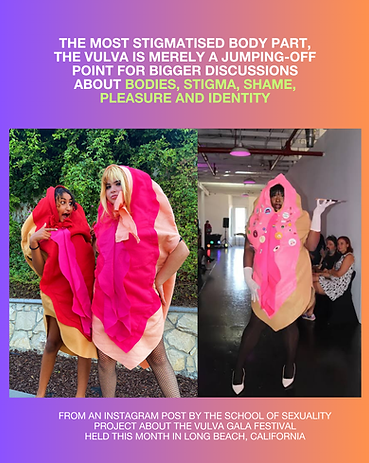
ON THE VULVA GALA FESTIVAL & ITS BODY-POSITIVE COSTUMES
For the Vulva Gala Festival, held on 15/8/26 in Long Beach, California, the School of Sexuality Project said it would be: “Bringing body literacy, wearable art, drag and community healing into a Long Beach church for one unapologetic night…
By putting vulvas and conversations about sexuality at the centre of
a joyful, creative public space, we challenge the idea that these topics should be hidden, clinical or shameful.’
The Hollywood Times reflected: ‘This annual celebration is a grassroots revolution that has helped initiate positive and impactful conversations around bodily autonomy, identity and sex education.
[Holding the gala in a church shifted] the environment’s attentionaway from religious worship to invite honest reflection on how countless institutions of power shape our relationships with our bodies. [It was]
a space to address historical harm and personal healing.
The Fashion Show is the heart of the Vulva Gala. Local artists showcase wearable power vulvas brought to life by a diverse array of vulva-positive models.
These wearable art pieces are later put up for auction to fund the School of Sexuality Project’s sex ed curriculum and workshops providing inclusive, trauma-informed resources to parents, teachers, college students and the public.
[The idea is to] challenge stigma, centre joy and celebrate bodies.
We had so much fun and were so inspired at the first Vulva Gala in 2024 that I (Alex Banx) will be one of the designers sending my own passionately designed vulva werking down the runway”
WORDS Attack of the 5 ft. 2″ Vulvas, A Love Attack! (The Hollywood Times, 18/7/26)
AND…
• “We have activities planned for young ones! Just know some art might bring up some questions for littles. We are here to help you answer them in an age appropriate [way]”
• “The vulva is merely a jumping-off point for bigger discussions about bodies, stigma, shame, pleasure and identity. By centring the most stigmatised body part, we open the door to conversations that shift the way we think about the body”
• Banx says that KailaYu’s memoir Fetishized “got me thinking how little we look at our own vulva and how that’s likely the one part of our body more of the world has seen than us who own it”

ON THE MANOSPHERE FUELLING MISOGYNY AMONG BOYS
“Nearly a third of young boys believe men have more of a right to a job than women, a new Australian study reveals. Teens as young as 13 are showing alarming signs of misogyny and display hostile attitudes towards women and girls.
In the study of 1,100 young people – whose views on gender equality were compared to those of 2,300 adults – 31.8% believe attempts to give equal opportunities to women have gone too far, while 30.1% think men have more of a right to jobs when opportunities are limited.
Nearly a quarter believe feminism is damaging to our society – and should be resisted with violence if necessary.
Study author Dr Sara Meger, from the University of Melbourne says: ‘What’s perhaps most worrying is that this isn’t a story about adults radicalised in the dark corners of the internet. Teenage boys were the most likely to express misogynistic attitudes, mistrust of women and a belief in rigid traditional gender roles. Engagement with manosphere content, porn and online dating showed the strongest links to misogynistic views.’
Teachers report students quoting influencers like Tate and repeating manosphere language in class to justify refusing instructions from female staff while complying with instructions from male colleagues.
This behaviour was reported among children as young as 6.
Dr Meger says: ‘This study shows that the problems with misogyny are structural, not individual.’
Teenage girls aren’t immune to the widespread effects of misogyny, the study shows. Younger girls are more likely than older generations to agree to ideas of male sexual entitlement.
Gen Z women, aged 14-29, are twice as likely as millennial women, aged 30-45, to agree that marriage entitles a husband to sex with his wife even if she does not want to.
Teach Us Consent CEO Chanel Contos says the findings highlight the impact of harmful online content on young people: ‘Our social media feeds and algorithms are fertile ground for content that promotes violence against women and girls (VAWG).’
This year a poll of 500 boys aged 11-14 in the UK revealed 73% have seen misogynistic or harmful content online – on average within 18 minutes of logging on.
That has risen from 69% two years ago, demonstrating how algorithms are targeting boys with an increasing stream of negativity. Experts say over time this content desensitises them to harmful views.
Our Watch CEO Patty Kinnersly says the study ‘adds to the growing evidence that misogynistic attitudes are linked to real-world violence and harm. The good news is these attitudes are not inevitable, and we know what helps prevent them from taking hold. Given these attitudes can form during adolescence, prevention has to start earlier’”
WORDS Boys as young as 13 are showing signs of misogyny: Study reveals 30% of youngsters think men have more of a right to a job than women (Daily Mail, 18/8/26)
.png)
ABOUT GUIDANCE ON SEXUAL CONSENT FOR UK ASYLUM SEEKERS
“Do not rape or sexually harass people, including partners and children, says a guide for asylum seekers published by the UK Home Office. It tells people arriving in the UK after fleeing other countries that women are allowed to ‘earn their own money’ and ‘make their own decisions about their lives’. Men appear to be the primary target for the instructions.
A series of posters has also been designed.
The guidance states that people are expected to not make sexual remarks about someone ‘even if you think it is a compliment’, whistle or make ‘kissing sounds’ at someone, follow someone or ‘block their path’, make rude or offensive gestures or ‘verbally abuse someone because of their gender, religion or how they look’.
People are warned it’s a serious crime to take or share sexual images without someone’s consent.
Sections include gender equality, domestic abuse, sex and consent, and respect in public.
Conservative shadow home secretary Chris Philp said: ‘Instead of trying to train these mainly young, male illegal immigrants to behave in a civilised way towards women, they should be deported.’
The guidance says: ‘Everyone in the UK is expected to treat men and women equally’ – and ‘even if you are a family member, like a husband, father or brother’, you must never stop a woman working or studying, control what she wears or where she goes, or make decisions for her without her agreement.
Domestic abuse is defined as physical violence, threats, controlling behaviour, emotional abuse or taking away someone’s papers.
Asylum seekers are told they should never physically or verbally abuse or control their family and partner.
The sex and consent page explains that both people must consent to sex without threat or pressure, someone can change their mind at any time even if they agreed previously, and someone ‘asleep, drunk, or unable to respond’ cannot consent.
It adds: ‘Consent is needed in every situation. This means even if you are married or in a relationship with someone, they must consent to sex every time.’
Anyone under age 16 is considered a child and therefore legally cannot consent to having sex”
WORDS “Don’t rape, sexually assault or make kissing noises”, asylum seekers warned in guidance about living in UK (Sky News, 20/8/26)

ON CHOKING BEING NORMALISED AMONG YOUNG PEOPLE
“British teens as young as 14 will be taught that strangling someone during sex can put them in prison. This comes after growing concerns over ‘the normalisation of choking’ among young people.
The lessons will also teach teens about issues such as not to assume ‘blanket consent’ during intercourse, setting boundaries with a partner and recognising toxic relationship behaviours, which include phone snooping and gaslighting – emotional abuse that leaves victims questioning their memory.
The strangulation warning is part of the new Relationships, Sex and Health Education (RSHE) curriculum for kids aged 14-15 – statutory guidance that comes into force in September with Oak National Academy lessons.
Oak says it will help teachers tackle the ‘growing influence of the manosphere and incel culture’ in classrooms. Intentionally strangling or suffocating someone is a criminal offence punishable by up to 5 years in prison.
There is a defence in law if an accused can show that an alleged victim consented to strangulation or an act that affects the ability to breathe. This doesn’t apply if the victim suffers serious harm or the accused intended to cause serious harm or was reckless as to whether the victim would suffer serious harm.
The lessons will make clear to young people that they can’t rely on consent as a defence. Schools minister Georgia Gould says: ‘We are using every possible tool to achieve our mission of halving violence against women and girls VAWG. Misogynistic views are not innate – they are learned.
Our new RSHE guidance will help challenge and tackle harmful myths and behaviours early. Teachers will have everything they need to have these conversations safely and confidently.’
Oak CEO John Roberts says: ‘We can’t run from difficult topics, otherwise young people are left to navigate them alone. The new guidance will bring a lot of sensitive discussions into classrooms. That’s a good thing’”
WORDS Teens to be taught strangulation can put them in jail after “choking normalisation” concerns (Daily Mirror, 15/7/26)
AND…
• “43% of sexually active 16- and 17-year-olds in the UK have experienced strangulation. The government plans to ban its depiction in porn.
Oak warns that many young people appear to believe it is legal as long as consent is given and no visible injury results from it”
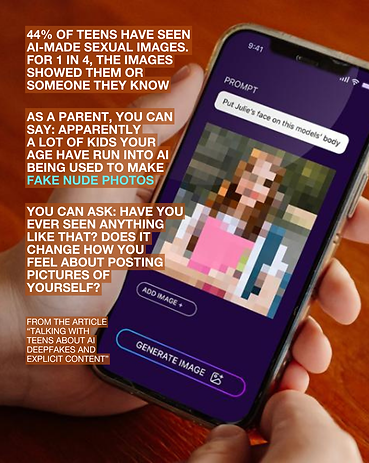
ON TALKING TO YOUR CHILD ABOUT DEEPFAKES AND AI
“Some kids come across deepfakes by accident, scrolling through a social media feed or in a group chat. Others try making it, maybe messing around. And some are the target: someone uses an app to turn their photo into a fake nude photo or video then shares it around school or online without the person knowing.
A lot of kids are already dealing with this whether we talk about it or not.
A sexual image of an under-18 can be considered child sexual abuse material – a serious crime. Kids should know that if this ever happens to them or a friend, they can talk to a trusted adult, report it to the app or website, or reach out to organisations that can help.
It’s important for adults to bring up the topic first. Use it as a chance to talk about the basics: respecting boundaries, asking before sharing anything, understanding that consent matters online. You don’t need to have all the answers. Just let your child know you’re a safe person to come to.
Some conversation starters…
DEEPFAKES ARE PERSONAL 44% of teens have seen AI-made sexual images, according to Common Sense Media. For 1 in 4 the images showed them or someone they know
• SAY I read about AI being used to make fake nude photos. Apparently a lot of kids your age have run into it
• ASK Have you ever seen anything like that? Has anything like that ever happened to you or someone you know? Did it change how you feel about posting pictures of yourself online?
KIDS MAY NOT UNDERSTAND HOW DEEPFAKES CAN HURT PEOPLE About 25% of teens think AI-made nude photos are less harmful than real porn because: ‘No one gets hurt’
• SAY The person a photo is made to look like is real. So is how humiliated or scared they’d feel if it got passed around
• ASK Does an AI nude feel different to you from a photo? How do you think you’d feel if it happened to you or a friend? Do apps that make someone look older or appear in a different outfit make fake AI photos feel too easy or normal?
KIDS MAY NOT UNDERSTAND THE CONSEQUENCES OF DEEPFAKES 82% of teens who see AI-made sexual content say it should be illegal to make without permission. But it’s so easy to create & share that many do it anyway
• SAY If someone uses AI to make a fake nude photo of an under-18, that can count as child porn – a felony. It doesn’t matter if it’s a joke or looks fake. I just want you to know it before it’s ever a problem
• ASK Did you know that?
MOST TEENS HAVEN’T TALKED TO A TRUSTED ADULT ABOUT THIS Only 20% of teens have talked with a trusted adult about AI-made sexual content. About a third want to talk about it but don’t know how to start
• SAY If you see something upsetting like this, whether someone sent it to you or it was about you, you can come tell me. You won’t be in trouble
• ASK If something like that happened to you, would you know what to do first? Who would you want to tell?
SOME TEENS ARE DEEPFAKE CREATORS 18% of teens have made AI sexual content or know someone who has, 25% have shared this content or know someone who has, 63% of those teens made content showing themselves or someone they know and boys are almost 3 times as likely as girls to have made it (11% vs 4%)
• SAY There are so many AI apps now I can’t keep up. Can you show me a couple that you or your friends use?
• ASK Which ones could be misused to make something like a fake photo?
As with talks about sex and porn, aim for a series of short chats, not one big talk. Stay open, avoid judgment and expect that the conversation may be brief. Your teen might not say much (at first or at all) but it’s a conversation worth having”
WORDS Talking with Teens About AI Deepfakes and Explicit Content (Common Sense Media, 21/7/26)
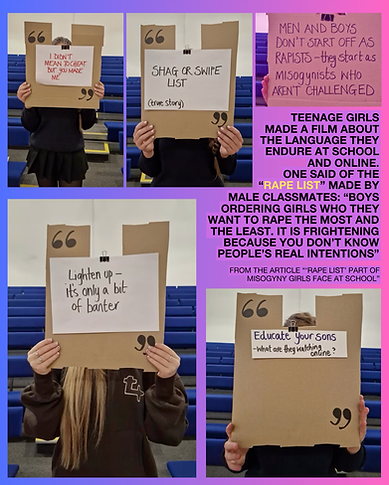
ON MISOGYNY & BOYS HAVING A RAPE LIST AT SCHOOL
“Teenage girls in Tyneside, northeast England, say they feel ‘worthless’ and ‘frightened’ as a result of the extreme misogyny they regularly experience. They spoke out after making a film about the language they endure at school and online.
Many comments are too explicit to share but include threats of violence and rape often masked as ‘banter’. One girl felt ‘worthless’ after learning of the ‘rape list’ made by boys in her school: ‘Boys ordering girls who they want to rape the most and the least. It is frightening because you don’t know people’s real intentions.’
The government aims ‘to halve violence against women and girls’ (VAWG), with changes from September to help teachers challenge misogyny – defined as a contempt for, hatred of or prejudice against women. Charities warn that unchallenged attitudes could lead to abuse in early relationships.
Impact Family Services CEO Catherine Marchant says young people could become unaware of abuse in real life if violent misogynistic attitudes were normalised in schools and on social media: ‘It’s very concerning. We’re seeing this across the region in all schools. Sadly young women aged 15, 16, 17 now recognise they were abused in their first relationships. They think this is what relationships are about. They see it online, hear it in music. If nobody calls this out and tells them it’s not right, they think this is how they should behave.’
Breaking the cycle of abuse has to begin by educating young people: ‘We’re almost having 13-year-old girls being raped by 13-year-old boys. But nobody’s told the girls that boys shouldn’t do that to them and in some cases nobody’s told the boys they shouldn’t.’
The film, made with This Life Collective, was shared with the government and the director, Sue Davison, says it should be shown in UK schools. She says the rise of toxic masculinity among social media influencers had a serious impact on ‘disenfranchised boys. The language is getting more violent and aggressive. Huge numbers of boys do not take part in this behaviour and they are really made uncomfortable by it. We talk to the girls about: 9 out of 10 boys would never take this further than language, which is bad enough, but it’s that one possibly out of 10 that might.’
The girls changed their behaviour to feel safer, avoiding large groups of young men and sticking together when they go out at night.
‘It shouldn’t have to be like that,’ one says. ‘I should be able to walk home the quick way. But I’d prefer to take the long way round so I know if anything was to happen there were people there. It’s just like an instinct. You just do it because it’s like fight or flight.’
The students hope their film will help challenge attitudes and encourage discussion.
Dr Alex Blower – a researcher specialising in masculinity, inequality, and education – founded Boys’ Impact, a UK-wide network to improve opportunities for young men from working-class backgrounds.
He praises the bravery of the girls for sharing their experiences and says more work needs to be done ‘with boys and young men to create a hopeful, values-based expectation for the type of dad, mate and romantic partner they can be’.
While there has been clear messaging for girls and young women about empowerment over the last 40 years, boys were left behind: ‘We haven’t created a parallel narrative for boys and young men surrounding what a happy, healthy, successful future looks like for them. Instead we’ve left a void which has been filled with nefarious online actors peddling their own narratives surrounding what a successful manhood looks like.’
Blower says schools often start with the assumption that there’s ‘something inherently wrong with being a boy’ rather than creating conversations about the type of man boys aspire to be and how they can be supported.
A government spokesperson says: ‘Violence against women and girls [ is] one of the most pressing challenges facing our society today.’
Conservative leader Kemi Badenoch says only a minority of boys were the problem, adding: ‘I don’t want us pitting boys and girls against each other’”
WORDS “Rape list” part of misogyny girls face at school (BBC, 4/8/26)

A WARNING TO PARENTS TO NOT POST PHOTOS OF THEIR CHILD
“Parents should not put photos of their child online, says landmark guidance issued to tackle the rise of AI-generated sexual abuse material. The National Crime Agency and Internet Watch Foundation fear that most people are unaware of the dangers posed by paedophiles and criminal networks.
They suggest that parents make social media accounts private or share pictures of their child in a ‘close friends’ group.
The guidance recommends auditing social media for old pictures
that can be used by predators and revisiting photo consent agreements – eg with a school or club – signed before AI made image manipulation possible.
It also recommends checking privacy settings on social media, reviewing who can see kids’ images and discussing permission for people and organisations to publish images online.
‘We encourage parents to take a few simple steps today,’ says Tim Wright of the NCA, which claims that most parents aren’t aware that tech advances gave criminals publicly available tools to create child sexual abuse material (CSAM) without needing to contact or groom victims directly.
‘A picture of a child online might be scraped to be turned into CSAM,’ says Lorna Sinclair, NCA child sexual abuse education manager.
The amount of AI-generated images and videos of realistic CSAM rose by 14% in 2025.
The IWF, which monitors CSAM incidents and runs a reporting hotline, has been contacted by under-18s who were blackmailed by extortionists after their images were nudified by AI.
A confidential service that removes explicit images of under-18s taken without consent, Report Remove, reports image manipulation involving clothed selfies being converted into extreme porn.
A girl aged 15 says a stranger made a ‘convincing’ fake nude of her using her face and bedroom with material from her Instagram account, says Childline.
UK school websites have been targeted by blackmailers who scraped pictures of kids, converted them into CSAM then threatened to publish the results. A UK advisory body on tackling online harms, the early warning working group (EWWG), recommends that schools remove identifiable pictures of kids’ faces from their website and social media accounts.
IWF chief technology officer Dan Sexton is ‘uncomfortable’ telling parents not to put pictures of kids online but says: ‘I don’t know what else to say to parents. I would be very cautious because there is no protection.’
The NSPCC recommends under-18s keeping social media accounts on a private setting.
Advice on carrying out a social media audit includes users checking their social media accounts to gauge whether their child’s ‘face, body or school uniform’ can be seen, whether they are comfortable with the image still being online and whether it can be deleted or made private. It also recommends checking whether friends or family have uploaded images of a child, including historic posts and discussing ‘clearly and calmly’ what action could be taken with those posts”
WORDS UK parents warned over posting images of children amid AI sexual abuse fears (Guardian 3/7/26)

ON THE IMPACT OF PORN ON KIDS
“When film director Beeban Kidron set out to investigate the harm being done to kids in the online world, she created avatars based on young people. These digital characters had specific genders, ages and interests. They used particular devices, apps and platforms. The aim was to find evidence ‘of what children encounter online, information fiercely guarded by tech companies’.
Within hours of the avatars going live ‘online services targeted the boys’ avatars with porn, adult contacts and sex workers – despite not one of them searching for it. Most of the girls’ avatars were targeted with self-harm or extreme diet material they had not searched for.’
Kidron says: ‘A child became, in system terms, a set of signals to be acted on – where vulnerability could be treated as opportunity and a child could be seen merely as a target for advertising, self-harm or porn.’
Her 2021 research replicated the real world. Kidron says 59% of children have been exposed to porn without searching for it, at an average age of 13.
A boy showed her Pornhub videos on his tablet called ‘grandmas you’d like to fuck’. He was ‘upset about the burden of being addicted (his word) to a limitless stream of commercial sexual material. His addiction was time consuming, isolating and maybe – he suggested – a little demeaning.’ His parents were unaware.
Kidron says: ‘Once a child is in a loop of adult or harmful material the bombardment is overwhelming.’
Porn is changing young people’s attitudes to relationships. A third of UK women aged 16 to 35 have been ‘non-fatally choked – strangled – during sex’. A radiologist says guidance has been changed to routinely check women and girls’ necks during postmortems. Kids are being radicalised and drawn to extreme violence online. Almost a third consider a chatbot a friend.
Kidron, author of Users: How Big Tech Took Control And How To Fight Back, says: ‘We are at tech’s tobacco moment.’
In 2012 she ‘walked into my kitchen and found four 15-year-old girls sitting silently on the sofa, each staring at her own device. What would normally have been bubbling chat and giggles had been replaced by intense concentration broken only by the restless tapping of fingers.’
In 2013 she made a documentary, InRealLife, about teens’ relationship to the internet, concluding: ‘Children are no match for an online world designed by adults for adults.’ Once they are exposed to extreme violence or sexualised content, they can’t simply return to being children: ‘It’s a generational injustice.’
Kids are fed the same horrific material as adults and every bit of information they offer up about themselves is stored. By the time a child reaches adulthood, the cumulative number of discrete data points collected about them can reach into the trillions: ‘What looks like participation is also extraction… Routine bullying, overexposure, bad information, violent misogyny and sexualised content. Grooming, scamming and being primed and nudged to gamble. The distinction is not that children face different harms but that they encounter the same harms earlier, faster and without the emotional, cognitive or social maturity to tackle them’”
WORDS Beeban Kidron’s Users calls out the tech bros making billions selling porn to children (Observer, 25/6/26)

ON YOUTUBE RECOMMENDING UNHEALTHY EATING CONTENT
“YouTube still recommends eating-disorder videos to teenage users a year after rules were introduced to curb harmful online content.
The Centre for Countering Digital Hate (CCDH) set up a simulated account for a 13-year-old girl viewing unsafe diet and body-image content for the first time. One in 10 videos recommended by YouTube’s Up Next algorithm featured thinspo (short for thinspiration), extreme calorie restriction or other harmful material and eating-disorder content, although the situation has improved over the past 2 years.
Google, which owns YouTube, says the videos cited in the report were removed.
‘With vulnerable users, just a small algorithmic nudge can be enough to push them into a very dangerous situation,’ says CCDH senior research manager Alexandra Johnson.
Content still recommended by YouTube included a thinspo account showing a compilation of girls idealising extreme thinness; a video promoting a diet with a daily intake of just 170 calories, far below the healthy level for teens; and a video claiming to help users lose weight subliminally that linked to a document promising ‘the most emaciated skeletal dainty body eva’.
YouTube has launched videos from experts that appear when a teen account searches for a topic like depression or eating disorders.
88% of 3- to 17-year-olds say they use YouTube.
About 90% of the people that eating disorder charity Beat speaks to report encountering harmful content online.
Beat says users can turn off notifications, use apps that limit time spent online or select the ‘Not interested’ option on content. Accounts sharing harmful material can be blocked, muted and, where appropriate, reported.
Telecoms regulator Ofcom said YouTube and TikTok were not doing enough to keep young people safe.
Sites like YouTube have a legal duty to protect under-18s from dangerous content including videos that encourage or promote suicide, self-harm and eating disorders. They must also consider how their algorithms could be harmful to young people and mitigate risks. If not, they can be fined up to 10% of their global revenue.
Jazmin Kaur, 22, from Leicester who had anorexia at age 13 and treatment for 6 years: ‘I wanted to get fitter and healthier, so I took social media very much at face value without understanding the facts. I was fed such extreme content towards the end that I took it for my own vulnerabilities.’
At university Kaur deleted her social media accounts”
WORDS YouTube still recommending eating disorder videos to teens, research finds (BBC, 14/7/26)
AND…
• Children and young people who call Childline talk “about their fears of wearing certain clothes, including swimsuits, and how they feel under pressure to look a certain way.
They also mention comparing themselves to influencers they see online. Some talk about watching ’What I eat in a day’ and calorie-counting videos, which often promote unhealthy habits such as extreme calorie restriction.
Last year TikTok banned the hashtag #SkinnyTok to prevent young people from being exposed to dangerous eating-disorder content. But Childline is still hearing from young people who are watching these types of videos on TikTok and other platforms”

ON THE IMPACT OF MEN’S FASHION LOOKS GOING ULTRA-SLIM
“In men’s fashion an ultra-slim silhouette has emerged. With second-skin garments and very skinny jeans at Prada, Dior Men and Gucci, it seems the GLP1 effect that hit womenswear a few seasons ago is taking hold of men’s fashion, sparking debate.
Also there was an increase in jacked, muscular models dressed in ultra-short shorts and second-skin separates to show off their bulging quads and pecs as the looksmaxxing movement gains steam.
But where are the bodies that replicate those of customers?
Size inclusivity has never been a priority in menswear. Representation of plus-size bodies on the runway has stagnated. Men’s fashion refuses to cater to and represent men with bigger bodies. It’s moving the goalposts on body ideals further as slim models get slimmer, musclemen get bigger and shows reflect an untenable body image inspired by looksmaxxing, which is unachievable for the average person without help from peptides and/or GLP-1s.
GQ style editor Mahalia Chang: ‘There’s a bit of a backwards slide in terms of inclusivity. The skinny fit is back. It’s not a look you can wear if you’ve got anything resembling a bum, quads or calves, which most of us do. That flowy, oversized thing seems to be trending away’
Harrods menswear buyer Yasmin Mehmet: ‘We’re seeing a shift away from oversized silhouettes. There’s a renewed focus on the body’
Photographer JoFetto: ‘[Designer clothes are] more an idealisation of a form than a portrayal of who could wear the clothes day to day’
Dazed executive editor Jack Sunnucks: ‘I don’t think size inclusivity has evolved or that I’ve ever seen plus-size male models. It’s hard to fit into designer clothes. If silhouettes are going to be teeny weeny and tailored, that bodes badly. We’re living in a skinnier time, due to Ozempic and its cousins. That was always going to come for the runway’
MyTheresa menswear buying director Sophie Jordan: ‘Lower-rise, slimmer silhouettes and the gym aesthetic are challenging for our customer’
Stylist Declan Chan: ‘We can see a resurgence of the Hedi Slimane skinny ideal for models in the pursuit of youth. We’re in the weight loss era powered by injections and medications’
Designer Tomo Koizumi: ‘As long as oversized silhouettes remain in fashion, I can usually find clothes that fit me. But as the oversized trend fades I’ll struggle to find clothes in my size’
Odda editor-in-chief David Martin: ‘Size inclusivity in menswear is nonexistent. Menswear is for very young audiences with slim bodies or old-school elegance with a muscled appearance. We may need to re-understand how products adapt for all body types’
Stylist Jack Collins: ‘I understand why people can feel offended when they don’t see themselves. A lot of stylists decline jobs when a model or talent is bigger, taller, shorter, smaller, as it’s often deemed harder or more work’
Designer Achilles Ion Gabriel: ‘Fashion isn’t meant to be a mirror of society. It’s aspirational. Every now and then you see a model with a more average build, but menswear is still focused on slim bodies. Historically men weren’t under as much pressure from fashion. Today the pressure is coming from social media, dating apps, fitness culture and algorithms – big influences on how men see themselves. Fashion will always create ideals, but it’s competing with platforms that optimise appearance every minute of the day’
Stylist Paul Maximilian: ‘Real-size diversity on the runway is usually younger independent or queer designers. As a stylist you learn how to cheat a fit, eg leaving a shirt unbuttoned to hide where the waist doesn’t close. The system depends on adapting the body to the clothes. With silhouettes getting slimmer again, the conversation feels more urgent’”
WORDS “The Conversation Is More Urgent”: Fashion Reacts to Men’s Shifting Body Ideals (Vogue Business 6/7/26)

ON SEX ED PREVENTING VIOLENCE AGAINST WOMEN & GIRLS
“Relationships & sex education (RSE) for 16- to 18-year-olds could be made mandatory in a bid to prevent violence against women & girls (VAWG).
Alistair Strathern MP, co-chair of the Labour group for men and boys, says his draft law would extend the time pupils are taught how to navigate complex issues in relationships and recognise coercive control and other forms of abuse.
He says: ‘When the worst corners of the internet are preying on teenagers, with their own harmful takes on what makes a healthy relationship, we surely owe young people far better than this.
With 16- to 19-year-olds facing the highest rates of domestic abuse of any age group, the real-world consequences of failing to act couldn’t be clearer. Young people’s exposure to extreme content online makes this legislation more important than ever.’
The Relationships And Sex Education (Further Education Sector) Bill follows a petition by the survivor-led campaign group Make It Mandatory, which called for sex education to be mandated to 18 and gathered over 106,000 signatures. Founder Faustine Petron says: ‘As someone who experienced an abusive relationship, I know how important such a change could be.’
Sex Education Forum CEO Lucy Emmerson explains: ‘It makes complete sense to extend RSE to further education because this is the time when many young people will be starting their first romantic & sexual relationships.
Having reliable information about healthy relationships provided by trusted adults is proven to help prevent harm’”
WORDS Make sex education mandatory, says Labour MP (BBC, 17/6/26)
AND…
• 79% of young people have accessed violent porn by age 18 (Children’s Commissioner, 2023)
• 16- to 19-year-olds face higher rates of #domesticabuse than any other age group (ONS, 2024)
• Girls aged 15 to 19 & boys 10-14 are most likely to be victims of sexual offences (ONS, 2025)
• 72% of girls under 18 experienced emotional partner abuse and 31% of girls and 16% of boys experienced sexual partner violence (Children’s Society, 2020)
• 2 in 5 teens aged 13-17 in England & Wales experienced emotional or physical abuse in the past year (Youth Endowment
Fund, 2025)
• Average age of first sexual intercourse: 16
• Young people aged 15 to 24 years are the most likely to be diagnosed with the most common types of STI (WEC Report, 2024)
• 2 women a week are killed by a man in England & Wales (Killed Women)

ON HOW THE WHITE HOUSE CAGE FIGHT VENERATED VIOLENCE
“Were you not entertained by the human cockfight staged at the White House on 14 June? Blood and guts were the coin of the realm in Washington’s Ultimate Fighting Championship (UFC) extravaganza.
If the term toxic masculinity were in search of an illustration, President Donald Trump gleefully provided it with a testosterone-flood event. Even the scantily clad Octagon girls were about to sprout moustaches by the end.
Yes, some women enjoy the sport and some are fighters, though none competed on Sunday. Though it’s difficult to estimate the number of women who attended the fight fest, some notables included Ivanka Trump (who posted that the evening was ‘epic’) and Linda McMahon, CEO of World Wrestling Entertainment before Trump tapped her as education secretary.
At a time when toxic masculinity is a legitimate concern – and when boys and men suffer from a variety of problems related to education, jobs, relationships, isolation and depression – it is jarring to see the most extreme examples of masculinity highlighted by the president not only as entertainment but presumably as role models. I have no reason to think that those men in the cage are anything but good citizens, fathers, sons and brothers, but they don’t offer most of America anything to celebrate. Why not skip the pretence and bring in some lions and giraffes?
Don’t mistake me for an anti-male feminist: I wrote the 2008 book Save The Males outlining the early warning signs of the problems we’re seeing now. Would I rather watch the cast of Hamilton at the White House than men pummelling each other into bloody pulps? You bet. But there’s a chasmic difference between brilliant Broadway performers and hyped-up men kicking and punching for spectacle. I can’t bear to think what the rest of the world sees when it watches the most powerful country on Earth, the heart of democracy, descend into the primal muck where man-as-beast triumphs.
The People’s House has been so desecrated by this president with advisers who seem to have leaped from the cartoonist’s page, some unrecognisable from their pre-Trump photos. Does the White House commissary sell Botox and filler?
About the fighter who insulted former first lady Michelle Obama: real men don’t speak disrespectfully of others. I hate to break it to the young man in question, but I’ve been up close with Mrs Obama and she could break you. She’s no man, as he claimed, but she is one powerful woman.
Trump’s big beautiful brawl, with all its blood, sweat and smears, was an ‘epic’ embarrassment. The president gets his kicks from watching other people get knocked down. Our boys and young men deserve better, and so do our girls and women”
WORDS Trump’s big, beautiful brawl was the worst birthday present ever (Washington Post, 19/6/26)

QUEER AS COMICS EXHIBITION ACCUSED OF OFFENDING KIDS
🌈 “A gallery founded by Roald Dahl illustrator Quentin Blake, age 93, is displaying gay pornography in an exhibition easily accessible by children.
The Quentin Blake Centre for Illustration in Clerkenwell, London, has explicit sexual cartoons on display in its exhibition Queer As Comics.
Children are able to browse the exhibition, which contains 2 comics showing exposed men’s genitals and another where 2 naked women are having sex.
Lucy Marsh of the Family Education Trust [a campaign group opposing the rights of LGBTQ+ people], said the cartoons should be removed: ‘Most families will associate Blake’s illustrations with their children’s favourite Roald Dahl books, so would never imagine that the exhibition would contain explicit sexual images.
This is a massive breach of safeguarding, as exposing children to adult sexual content can be classed as non-contact child abuse.
The organisers should remove the pictures immediately or inform families that the minimum age is 18+ due to the obscene pornography.’
One attendee was alarmed to see boys and girls younger than 5 at the exhibition, which showcases comic strips drawn by gay artists.
A sign outside the gallery, which markets itself as a family-friendly attraction, warns visitors that ‘some works on display reference or depict sex’.
But children aged 13 or below can still enter if accompanied by an adult and those aged 14 to 17 can go in alone.
The gallery’s library also displays a book called Tom Of Finland – whose covers show a nude moustached man and 2 men in an embrace with one holding the other’s crotch – just a few feet from a children’s area. The book is about Touko Laaksonen, a 20th-century Finnish erotic artist.
The Queer As Comics exhibition is advertised with a cartoon of 2 men kissing and says attendees will ‘discover stories of fantasy, identity and resistance’”
WORDS Quentin Blake gallery displays gay pornography to children (Telegraph, 27/6/26)

ON TOPLESS PHOTOS OF GIRLS AGE 16 IN BRITISH NEWSPAPERS
To compete against other UK tabloid newspapers – such as The Sun, with its topless Page 3 girls – the Sunday Sport launched a feature in 1987 “counting down to the 16th birthday of schoolgirl Natalie Banus – when she could legally be pictured topless.
Owned by the porn baron David Sullivan, who recently resigned as director of West Ham football club, the Sunday Sport had devoted countless column inches to the teenager they called ‘the sexiest 15-year-old in Britain’, measuring ‘a fantastic 40-22-34’.
In the first picture she was semi-naked, her chest obscured by her arms. The paper said it was compliant with the law (not publishing indecent images of under-16s), as Banus was ‘not quite topless’.
It called 15 ‘the age of the nymphet’ and Banus ‘the sexiest Lolita of them all’. Topless pictures of her were published in its sister paper, the Daily Star, when she turned 16. It ran topless pictures of her ‘all week paired with some nonsense story about me being so proud of my tits, getting groped or fantasising about sex’.
Banus reflected on her glamour modelling career in the memoir Dark Star, out this year: ‘The Sunday Sport told readers I was legal, meaning I could show my boobs and that anyone who had sex with me no longer had to fear they might be arrested.’
Sullivan’s career in the adult entertainment industry has been thrown into sharp focus, with 7 women accusing him of sexual misconduct – 3 alleging he preyed on them for sex when they were seeking work and 4 accusing him of exploitative and predatory behaviour, including trying to pressure them into sex during business meetings.
Former models and industry insiders say he was known for so-called casting couch behaviour. Allegations span decades from the 1980s and involve women in their late teens and early 20s.
The Sunday and Daily Sport continued for over 15 years to celebrate girls’ 16th birthdays by picturing them topless. Some teen models were bruised by exposure to the sleaziest end of Britain’s newspaper market. Some were encouraged to share details of supposed sexual experiences, which several later alleged were exaggerated or made up.
In 1994 a bikini-clad Linsey Dawn McKenzie appeared with the headline: ‘Please print my boobs when I’m 16’. Over 6 weeks it printed its favourite reader pictures of how they imagined she would look topless. On her birthday it said: ‘Lovely Linsey Dawn McKenzie – sweet 16 and stripped bare for YOU’.
In 1998 Zoe Parker, scouted weeks after her stepfather took her to a porn fair, appeared topless with the headline: ‘I’m sweet 16 and I can’t get enough’. The article detailled her supposedly outrageous sex life.
In 2003 Cherry Frampton appeared in lingerie and suspenders with: ‘She’s sweet 16 and just left school, her boobs are 32E and still growing. Tomorrow, only in the Sunday Sport, she’s getting them out!’ then: ’Happy 16th bare-day’.
In 2004 it became illegal to publish indecent images of under-18s.
Sullivan’s history has not precluded him from reaching the pinnacle of British sport and exercising control over not just a prominent football club also but its women’s team and academy system for children. He remains its largest shareholder”
WORDS Revealed: David Sullivan’s Sunday Sport sold sexualised images of 15-year-old girls (Guardian, 8/6/26)

ON CRITICISM OF SESAME STREET’S ANNUAL PRIDE MONTH POST
🌈 “It’s Pride Month and a post from Sesame Street on X recognising Pride Month sparked a ton of outrage. Again.
For years Sesame Street has celebrated Pride Month on social media, but each year the posts shock critics. They were also horrified when Elmo posted about Bad Bunny’s halftime show performance.
Last year Sesame Street posted a loving message that advocated for acceptance: ‘On our street, everyone is welcome. Together, let’s build a world where every person and family feels loved and respected for who they are. Happy #PrideMonth!’
Daily Wire host Michael Knowles wrote about ‘publicly funded puppet show promoting weird sex stuff to your 3-year-old’. Critics told him that if he thought that’s what the post was about, it was his problem.
This year Sesame Street posted: ‘Happy #PrideMonth from Sesame Street! Join us in celebrating and uplifting the LGBTQIA+ members of our community.’
Conservatives again accused Sesame Street of being ‘creepy’ and ‘grooming’ kids. Reactions included: ‘This post is so inappropriate. Just teach them a,b,c, and numbers’ and: ‘You’re now pushing a sexual agenda on kids?’ and: ‘Toddlers don’t need representation
for sexualities.’
Turning Point USA posted: ‘This is literally a show meant for young children.’
In response some people were basically like: ‘Yes – and?’ Replies included: ‘Womp womp cry that children are shown inclusivity and teach kids to love people that are different from them’ and: ‘Do you realise there’s a difference between teaching children to accept others versus telling children to be gay.’
Several people pointed out that some kids who watch Sesame Street could have queer parents & that toddlers don’t have X accounts so they wouldn’t see posts anyway.
One person wrote: ‘The question hateful people keep asking: Why is a children’s show celebrating Pride! Because LGBTQ+ people include children too. And they also include families with children. Is that really so hard to understand!?’
Another person sarcastically wrote: ‘How dare (Sesame Street) teach kids tolerance, inclusion and to be a decent human being towards others even if they’re different’”
WORDS Sesame Street’s Pride Post Sparks Another Round Of Predictable Outrage (Little Things, 1/6/26)

ON ANOTHER ICE HOCKEY ROMANCE: OFF CAMPUS
Hard on the fantastic heels of Heated Rivalry comes “Off Campus, another adaptation of an ice hockey romance book. It’s Amazon Prime’s top show. Based on the series by Canadian author Elle Kennedy, which sold 25m copies, Off Campus is praised by fans for its portrayal of female desire, emotionally intelligent male characters and sports action.
Off Campus references the derogatory slang ‘puck bunny’ which is used for female ice hockey fans who are more interested in players than the game. But the show emphasises players wanting to respect women rather than use them and showing care about women’s sexual satisfaction.
Book content creator Meagan Carioti, age 27, says it is ‘so powerful’ to see a show in which ‘women’s pleasure and comfort are talked about, prioritised and valued. I love men written by women: the yearning is unmatched and it’s the female gaze – what women want. It is different from what men think women want.’
Content creator Oliver Zane, 25, whose TikTok Off Campus reaction videos amass hundreds of thousands of views, is a ‘sucker for girly TV shows. Female writers do a good job with character development, which makes them more realistic.’
Meanwhile the male characters don’t fall into the typical ‘jock’ stereotypes seen in sports dramas.
Carioti enjoys the juxtaposition of the ‘bravado’ of hockey & the characters’ ‘vulnerability underneath. The show is very female-centred: women are talked about and cared for in a respectful way, and the emphasis is on choice and consent. [The hockey romance genre] is just reduced down to "hockey smut" when it covers important themes like female empowerment and heavier topics like domestic abuse, sexual assault and violence.’ And domestic violence and trauma around rape.
Zane says: ‘We’re getting more stories about male characters being emotionally aware. I like seeing characters take accountability for their actions.’
He says it’s important that shows like this are not dismissed, especially now that ‘young men are being targeted with hypermasculinity’”
WORDS “Men written by women”: How ice hockey romances like Off Campus became TV’s hottest new genre (BBC, 30/5/26)
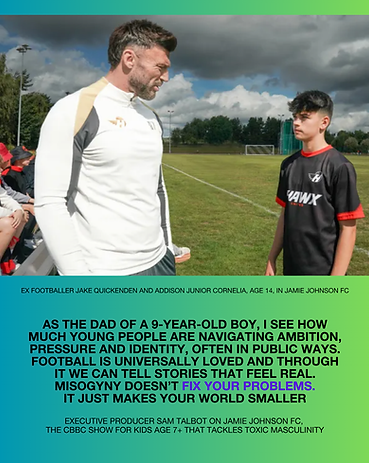
ON TACKLING TOXIC MASCULINITY WITH A TV SHOW FOR BOYS
“Toxic masculinity was dramatised in the show Adolescence before Louis Theroux tackled influencers in his Netflix documentary Inside The Manosphere. Now the CBBC series Jamie Johnson FC (available on iPlayer) addresses fame, masculinity & football culture for kids as young as age 7.
The producers were keen to prompt conversations between viewers and their parents, and to show young boys ‘you can push back, be accountable & be genuinely respected for it’.
The show’s message – eschew the attitudes adopted by influencers – is encapsulated by the coach telling a vulnerable player: ‘There’s more than one way to be a man.’
Cameos from footballers including Aston Villa star Ollie Watkins, manager Sam Allardyce and goalkeeper Mary Earps ground the drama in reality. It examines the pressures boys face & the exploitative nature of some male-influenced online communities.
Ex Scunthorpe United footballer Jake Quickenden, age 37, plays Richie Reeves, a charismatic Premier League star who seems to be a potential father figure for Baz (Addison Junior Cornelia), age 14, and offers him the seductively simple suggestion that his problems are down to the women and girls on his team.
Executive producer Sam Talbot says that as the dad of a 9-year-old boy, the storyline felt personal: ‘I see how much young people are navigating ambition, pressure, identity and often in public ways. As storytellers, we felt a responsibility to reflect that honestly but also to celebrate the strength, humour and resilience that sit alongside it. Football is a universally loved game & through it we can tell stories that feel real and joyful. That feels more important than ever right now.
Misogyny doesn’t fix your problems. It just makes your world smaller.’
Commissioning head Sarah Muller says that children’s TV plays a crucial role in reflecting young people’s realities: ‘By engaging thoughtfully with issues around identity, friendship & mental wellbeing, it offers young audiences stories they can recognise, talk about & learn from. It’s entertainment with meaning at its heart, drama that speaks honestly to its viewers’”
WORDS CBBC football drama to teach children about toxic masculinity (Telegraph, 3/5/26)

ON AN ART INSTALLATION ABOUT THE EPSTEIN FILES TOURING
“A New York installation displaying millions of physical files related to disgraced financier Jeffrey Epstein – the Donald J Trump and Jeffrey Epstein Memorial Reading Room exhibition – will be going on a nationwide bus tour. Trump’s name is mentioned thousands of times in the printed files.
Miles Taylor, a tour organiser and ex DHS (Department of Homeland Security) official turned Trump antagonist, said about the sheer volume of information the government had on the sex pest: ‘By the time you got to the end of it, it was a very powerful experience of sexual assault. People would leave in tears.
The Epstein files for a lot of folks are a news abstraction. For visitors it became an understanding of the magnitude of the victims and survivors, and also how deep the relationship goes between Trump and Epstein. You see the survivors’ memorial, the physical timeline, the literal weight of the literally tons and tons of printed files. It blows people away.’
On the nationwide tour – expected to launch after 4 July – celebrities might drive the bus at times. Lawmakers and congressional candidates say they want to make the tour part of
their campaign.
The Epstein files have been the one scandal the government can’t seem to get away from. Trump spent months pushing back on the momentum files released, calling them a ‘Democrat hoax’ and insisting that his MAGA base stop focusing on the late sexual predator.
After it became clear that there was unstoppable, near-unanimous support for the files’ release in Congress, Trump was forced to sign the Epstein Files Transparency Act into law in November. The Justice Department then released 3.5m documents, photos and videos.
About the tour Taylor says: ‘This is gonna get the president furious and keep the issue in the public consciousness’”
WORDS Trump Rebel to Take Epstein Files on National Tour (Daily Beast, 23/5/26)
AND…
• Cover To Cover Up was a 24-hour reading of the exhibit’s files from 18 to 19 May by the Save America Movement , the Institute for Primary Facts and public defender Eliza Orlins: “We broadcast live from inside The Donald J. Trump and Jeffrey Epstein Memorial Reading Room in Tribeca in New York City – a 5,000 sq ft public installation housing thousands of pages of unsealed evidence bound into almost 4,000 physical books.
Over 60 guests read out loud for 1,400 minutes. One minute for every one of the 1,400 victims.
With breathtaking candour, survivors themselves stood at the podium. To watch these women read directly from the files that describe their own personal pain, and the institutional failures and crimes committed against them.
By the time we hit our noon deadline, our readers had ploughed through roughly 3,000 pages of raw text. Those 3,000 pages represent less than 1/10th of 1% of just the files that have already been released to the public. And we know there is much more still being hidden from us”
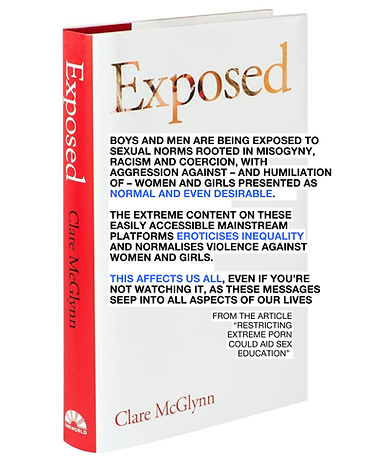
ON HOW MESSAGES IN MAINSTREAM PORN AFFECT ALL OF US
The author of the new book Exposed: The Rise of Extreme Porn and How We Fight Back, Clare McGlynn – a law professor at Durham University – explains that “restricting the availability of extreme porn could improve sex education and understanding around consent. She warns that widely available extreme content normalises sexual violence, with some young people first introduced to sex through it.
McGlynn says: ‘There’s an awful lot of non-consensual material on these websites that blurs the boundaries between consent and non-consent, which is confusing for young people.’
New laws are set to criminalise having or publishing porn which shows incest or adults pretending to be kids. Tech executives could also be fined or imprisoned if their platforms fail to remove non-consensual images.
‘If these laws were enforced, it could make a transformative difference to the type of material that’s easily accessible online,’ says McGlynn.
In drafting the law against creating non-consensual intimate images which came into force in February, McGlynn found that 1 in 8 titles on mainstream porn sites describe sexual violence.
McGlynn has called for an education campaign around strangulation, saying: ‘Boys and men are being exposed to sexual norms rooted in misogyny, racism and coercion, with aggression against – and humiliation of – women and girls presented as normal and even desirable.
The extreme content on these easily accessible mainstream platforms eroticises inequality and normalises violence against women & girls (VAWG).
This affects us all, even if you’re not watching it, as these messages seep into all aspects of our lives’”
WORDS “Restricting extreme porn could aid sex education” (BBC, 7/5/26)
AND…
• On the 8 May Woman’s Hour BBC radio show, McGlynn said of mainstream porn: “It’s not just that it’s gross and offensive but it reproduces the way the abuse is carried out. It’s like free propaganda for abusers.
We learn about sex from porn: what’s normal, what we want to do, to try out. It’s like a guide or sex education – we take it on board and act it out. That’s the impact it has on society”

ON EXPOSING A GLOBAL “ONLINE RAPE ACADEMY”
“The world was confronted by this form of internet-enabled abuse – which is teaching men how to abuse women and evade detection – in 2024 during the mass rape and drugging trial of Dominique Pelicot and 50 other men in southern France. Several of the rapists said they believed it was a part of a consensual ‘sex game’.
It was on a so-called dating website Coco, in a chatroom called Without Her Knowledge, that Pelicot was able to instigate the rapes of his then-wife Gisèle. While drugged unconscious by him, she was raped over 200 times by 70 men. While Coco was taken offline, other sites are springing up.
A CNN As Equals investigation uncovered a hidden online world where the commodification and amplification of sexual violence against women is flourishing. One porn site, Motherless.com, is home to more than 20,000 videos of so-called ‘sleep’ content uploaded by users. The website, which had about 62 million visits in February alone and whose core audience is in the US, calls itself a ‘moral free file host where anything legal is hosted forever’.
‘Sleep’ content is categorised with tags such as #passedout and #eyecheck. In these videos, men film themselves lifting the closed eyelids of women to show they are sleeping or sedated, with some ‘eyecheck’ videos surpassing 50,000 views. In the Motherless ‘sleep’ community members trade advice on how to drug their partners
Some users advertised livestreams, showing the abuse of drugged women in real time, for $20 per viewer.
One user claimed to be running a business dispatching ‘sleeping liquids’: €150 for a bottle of liquid he said was tasteless and odourless: ‘Your wife won’t feel anything and won’t remember anything.’
Zoe Watts learned that her husband of 16 years had been crushing her son’s sleeping medicine into her tea and raping her while she was passed out. She says: ‘We worry about who’s coming behind us walking down the street or even friending us on Facebook. We worry about going to our car late at night in a car park, but we don’t worry about who you lie next to. You don’t expect anything other than innocence to come from your partner.
I’ve had people say: “Yeah, but he’s your husband” or “But you weren’t awake” or “It’s not the same as being taken down an alleyway, is it?”’
Amanda Stanhope of Wigan, northwest England, was shocked by the initial police response to a video that showed her former partner sexually assaulting her while she was unconscious.
Some forms of porn have long normalised violence against women as entertainment, with algorithms that favour extreme content pushing exploitative material into the mainstream, experts say.
Clare McGlynn, a law professor at Britain’s Durham University and an expert on violence against women and girls, told CNN that the growing presence of voyeuristic material on mainstream porn sites ‘glorifies’ abusive behaviours both on- and offline. It’s a problem that ‘many men and people in society aren’t taking seriously enough’.
Men in these groups find a sense of community and perverse camaraderie as they normalise abuse. In the ‘sleep porn’ community, the thrill of the abuse is not only in the act but in the collective dynamic surrounding it, said psychologist Annabelle Montagne: ‘There is this notion of, almost, brotherhood.’ Participants find themselves ‘creating bonds’ that meet and reinforce their ‘narcissistic’ needs.
Sandrine Josso, a lawmaker who, after being drugged by a former French senator, has campaigned to raise awareness about drug-facilitated sexual abuse (DFSA), called the groups ‘schools of violence. I would even call them an online rape academy where every subject is taught. There are all the “subjects” and “disciplines” needed to become a good rapist or sexual predator.’
Perpetrators are pivoting to more ‘readily available’ prescription medicines that act quickly and leave little trace in the body compared to the ‘date rape’ drugs of the past”
WORDS Exposing a global “rape academy” (CNN, 26/3/26)

ON THE ABSENCE OF WOMEN AT THE SUPERPOWERS TABLE
A post on X viewed nearly 11.5m times shows the 14 May meeting between Donald Trump and Xi Jinping at the Great Hall of the People in Beijing, China. But “conspicuously absent were women from either delegation – a stark visual that quickly drew criticism from observers who saw it as an unmistakable display of patriarchal power.
In a tweet that attracted over 22,000 likes overnight, Harvard University economics professor Gita Gopinath wrote: ‘A painting of the end of meritocracy: A meeting of the two largest economies and not one woman at the table.’
Gopinath says: ‘We have somehow gravitated back to this idea that what matters is your network and not your capabilities – and that matters [in terms of] whether or not you get a seat at the table.
It’s just inexplicable how you end up with a single-gender table given the many talented women around the world.’
Halima Kazem of Stanford University’s program in feminist, gender and sexuality studies says: ‘We’ve gone backward. Obama-era US-China summits included women at the table. Now neither superpower thinks women belong in the room where great power politics happens. This isn’t just American failure – it’s a bilateral signal that women’s voices don’t matter in shaping the global order.’
Women at US-China bilateral meetings during Barack Obama’s presidency included China’s then vice-premier Liu Yandong, US national security adviser Susan Rice and Hillary Clinton, secretary of state.
Kazem pointed to the type of power being ostensibly signalled by both sides, saying: ‘This wasn’t about a lack of qualified women – both countries have plenty in their diplomatic and security establishments. This was a choice about what kind of authority to project: masculine, militarised and exclusionary.
When both superpowers perform power this way, they’re jointly defining what “serious” diplomacy looks like and who gets excluded from it.’
A small handful of women did accompany Trump on his 2-day visit, including his daughter-in-law Lara Trump, Citigroup CEO Jane Fraser and Meta president Dina Powell McCormick”
WORDS Photo of US-China delegation criticized over absence of women: “masculine, militarized and exclusionary” (Guardian, 14/5/26)
AND…
• “What we saw in Beijing was a choice of patriarchal power. What our world needs is what ex New Zealand prime minister Jacinda Ardern calls a ‘different kind of power’ grounded in empathy and a genuine willingness to collaborate across differences. Those are not soft virtues; they are the qualities that diplomacy between 2 rival superpowers demands.
The absence of women at the table is not just a failure of representation; it’s a failure of imagination of what leadership must look like. We deserve better and the world deserves better…
A study published in the Journal of Economic Behavior and Organization found that male-male negotiating pairs capture less value than any other pairing, because men overuse aggressive strategies against male counterparts, creating mismatches that collapse rather than build toward agreement. Men negotiating against men in high-stakes, zero-sum frameworks bring out the worst in each other. The aggression escalates. The impasses multiply. The deals collapse.
Research from Laura Kray at UC Berkeley and Jessica Kennedy at Vanderbilt found that women bring greater cooperativeness, stronger ethics and a measurable advantage in generating goodwill through problem-solving – traits that are ‘often overlooked or severely undervalued’. A Columbia Business School study found that women reach impasse roughly half as often as men in negotiations – 9% vs 19%. Less bluster. More deals.
Yet in 2023 women represented just 9.6% of negotiators and 13.7% of mediators across more than 50 peace processes analysed by the UN secretary-general. From 1992 to 2019, women made up a mere 6% of mediators in major peace processes. The UN called this ‘a stark reality’. We might call it something sharper: a catastrophic, decades-long strategic error with grave consequences.
Peace agreements with meaningful women’s participation are 35% more likely to last at least 15 years. Agreements without it are more fragile, more likely to collapse and more likely to return the parties to conflict”
• “Trump has continually excluded women from important meetings, whether it be when decisions are being made about women’s health or during international diplomacy meetings. Recently he turned a celebration of a women’s sporting team into a photo opportunity that centred men and relegated women to the background.
In 2026 these images encapsulate just how far the Trump administration has gone to roll back not just women’s rights but also the near total erasure of women from key moments when decisions are made”

ON A WAY FOR KIDS TO EXPRESS FEELINGS ON CONSENT ETC
“Vibe Check – an online tool encouraging reflection and accountability – talks young people who are questioning if they caused harm in a relationship through understanding if they violated a partner’s consent, apologising (when appropriate) and making sure they don’t repeat the behaviour.
This free, anonymous alternative to AI and online forums was developed by Safe Before Anyone Else (SafeBae), a survivor-founded, youth-led non-profit working to end sexual violence among teens. Since last month the site had over 3,500 visitors.
Vibe Check users can click through questions to get support working through their feelings (‘The person I was with is mad and I’m worried I did something wrong’) or reflecting on what happened (‘They seemed upset or distant after’). It offers mini-lessons on the nervous system’s freeze response, consent laws around alcohol and grounding exercises (‘If someone became distant, upset or quiet afterward, that can be a sign they didn’t feel OK about what happened. You don’t need them to “prove” anything for their feelings to matter. Accountability here can look like listening, apologising without pressure and respecting whatever boundaries they set’).
SafeBae strategic initiatives director Drew Davis was starting college 6 years ago when he noticed the growing phenomenon of people turning to Reddit forums with ‘difficult and vulnerable questions’. Studying forums for people recovering from eating disorders, he dug deeper and found a well of forums for people questioning if they had perpetrated a sexual assault.
‘It keeps me up at night how bad these responses’ in the forums are, says Davis: ‘Either you’re an awful person, there is no such thing as accidentally causing harm, you definitely did, to the extent that you should kill yourself – or you did absolutely nothing wrong, you’re perfect, women suck.’
After the Epstein files and ‘our frustration with how powerful men haven’t been held to account’, he says, we’ve seen communities wanting to hold younger and less powerful men accountable for their actions. Also ‘we have the manosphere, where people on these Reddit threads are creating communities on Telegram or on Discord where it is about hating women’.
Davis got concerned by growing levels of suicidal ideation among girls who survived sexual assaults and boys being isolated from their peers. He wanted to create a tool that could give people who may have caused harm in a relationship ‘an off-ramp to rejoin society, be in relation with other people and move towards accountability and repair for genuine mistakes’ and ‘take the onus off of survivors for having to lead these efforts for repair and apology’.
SafeBae’s youth board appreciated that Vibe Check offers ‘gentle, caring, compassionate pushback and redirection’.
Vibe Check ‘is intentionally not AI’, says SafeBae co-founder Shael Norris. ‘It’s based on over a decade of work with young people.’
Researchers are working to understand the effectiveness of AI for teaching sex-ed topics like consent. While AI tools show ‘real promise in making sexual and reproductive health education more accessible, private and user-friendly’, they perform better ‘when communicating about more straightforward topics, such as contraception’ than ‘when discussing more complex or sensitive topics, such as abortion or sexual pleasure’, says AI sex-ed tool expert Scarlett Bergam.
A recent UK study found that 1 in 10 young adults has consulted AI for sexual health information, and a 2025 Pew Research Center report shows that 1 in 5 teens have had a romantic relationship with a chatbot.
SafeBae youth programs manager Val Odiembo, age 19, says of high-schoolers: ‘A lot confide in AI.’ They turn to AI for advice about talking to a crush or for reassurance that they didn’t cross a line in a relationship. ‘AI will just tell you what you want to hear,’ she says, citing research that AI chatbots tend to affirm users’ actions even when they are harmful. ‘We’re also losing human connection when we confide in AI instead of the people closest to us.’
Apollo Knapp, age 17, hopes he can point preteens to Vibe Check before they come across any AI chatbots, saying: ‘If humans are messing up consent this much, I don’t even want to see what a robot’s going to do with it’”
WORDS Young people want to know whether they’ve perpetrated a sexual assault. A non-profit made a tool for them (Guardian, 6/5/26)

ON THE CREATION OF A 3D MAP OF THE CLITORIS
“One of the human body’s least studied organs, the clitoris, is
finally getting attention. It is a sensitive part of the female body
near the vagina that, when stimulated, can cause sexual arousal and orgasm. Many people are familiar with the clitoris’s external portion,
the clitoral glans, a bump located near the pee hole (urethra). But
the entire pleasure organ is bigger than what appears on the surface –
and in a study published on bioRxiv, researchers mapped out its
sensory neuroanatomy.
The study also referenced the clitoral hood, the V-shaped patch of skin and fatty tissue covering the pelvic bone (the mons pubis) and the labia.
‘There is a societal taboo attached to female sexuality. The taboo is an obstacle to conducting scientific investigation,’ said Amsterdam University Medical Center neuroanatomist Ju Young Lee. ‘Much more awareness is required, starting with the knowledge that the clitoris is actually quite large.’
While the penis’s sensory nerves were charted about 30 years ago, scientists are just starting to understand the clitoris. Research suggested it was at least 6 times more densely innervated than the penis, but understanding of the branching pathways of the main sensory nerve, the dorsal nerve, remained incomplete.
Lee and her colleagues created a digital 3D map of the organ’s complex neuroanatomy.
The findings, which address a decades-long research gap, are important for survivors of female genital mutilation (FGM), which affects over 230 million women worldwide. Studies indicated that almost 25% of individuals who undergo reconstructive surgery after FGM endure a decline in orgasmic experience.
The study can also inform operative procedures after child delivery, gender-affirmation surgery and genital cosmetic procedures.
The team’s results help ‘correct longstanding gaps and misconceptions in our understanding of female sexual anatomy’, says sexual wellbeing researcher Caroline Pukall.
The study didn’t examine nerves beyond those involved in sensation, such as the autonomic nerves that play a key role in arousal.
‘It opens the door, but we need larger studies to really understand the full picture,’ says urogynecologist Alexandra Dubinskaya. ‘Bringing this kind of knowledge into everyday practice and education has real potential to change how we care for women’”
WORDS Scientists Just Made the Most Complete Map of the Clitoris’s Sensory Nerve Network. Here’s What They Found (Smithsonian Magazine, 15/4)

ON THE PENIS-ENHANCEMENT DOCUMENTARY MANHOOD
“Manhood director Daniel Lombroso, says: ‘I’d read about the male loneliness epidemic, men doing leg lengthening and flying to Turkey for hair transplants. But with girth enhancement, the symbolism of the penis felt special and punchy.
A lot of these men have never spoken to anyone but then, weirdly, are comfortable with a queer practitioner holding their penis and a Jewish filmmaker from New York in a strip mall in Dallas. It’s their first time talking about their feelings.’
While insecurity may be an obvious motivator, the decision to have a procedure mostly had nothing to do with sexual performance. Many of those getting enlargements had trauma, often from childhood, and saw this as a way to regain some sort of control.
Funding a documentary with so much full-frontal male nudity was a challenge, says Lombroso: ‘Straight male execs were very uncomfortable with seeing penises and talking about penis size.
It was really women and queer men who understood it.’
The film never lets us forget the ecosystem of cruel cultural clichés around masculinity and those who sometimes heal, sometimes exploit male fears and shame around feeling lesser.
There is visual humour here, with an array of comically phallic objects, shapes and buildings.If the idea of needles going into penises and organs getting stretched makes you a bit queasy, take this as a gentle heads-up””
WORDS Manhood Investigates the Business of Male Enhancement (Outsmart, 13/3/26)
AND…
• Moore: “I can fill your penis with filler but I cannot fill the hole in your heart…
What makes you a strong masculine man is understanding that you have insecurities and that you’re able to open up and talk about them with your friends”
• “The narcissistic Instagram era can affect self-worth. Impossible physical standards for women are often discussed, but the pressures men face aren’t as widely talked about.
Moore is a trailblazer in penile enhancement, a core part of the sexual wellness industry. Overseeing countrywide practices, he tries to make penis enlargement via impermanent injections as everyday a practice as Botox.
Moore knows first-hand the shades of shame men can carry. We’re reminded that Viagra became a blockbuster drug overnight.
The film follows a nursing student whose identity as a gay man and OnlyFans sex-worker job were unwelcome in his conservative family, and a married dad of 5 addicted to the expensive process of injections who fell for rightwing podcasts about claiming one’s manhood”
• Lombroso says: “When I started the project, there were a few clinics. Now there’s 32”
ON GLORIFYING WAR & DOMINATION TO BOYS VIA VIDEO
“War has become clickable content. A week into the Trump administration’s illegal war on Iran, the White House released
a disturbing 42-second video on X. Splicing movie [and sports] scenes with military footage of actual strikes, the clip promised ‘justice the American way’ and played like an adrenaline-fuelled action-movie trailer.
The montage stitched together images of real missile strikes with pop-culture icons from Gladiator, Top Gun: Maverick, Iron Man, John Wick and even SpongeBob SquarePants. Critics mocked the video for reflecting the militaristic fantasies of teenage boys.
Actor Ben Stiller demanded the removal of a Tropic Thunder clip, saying: ‘War is not a movie.’
US political culture equates masculinity with domination and state-sanctioned violence. When leaders celebrate military strikes via action-movie tropes and video-game aesthetics, they reinforce the myth that a man’s strength is proven only by his capacity to crush an enemy.
The videos trivialise state violence – it’s what Reuters calls a ‘meme war’, a blend of Hollywood imagery and gaming culture with lethal military action linking masculinity and domination.
Boys are socialised through narratives where manhood is validated primarily through force. In movies, video games and political rhetoric, ‘justice’ is achieved through superior firepower. Empathy is dismissed as soft. Diplomacy is written off as naive.
The White House videos lean on Hollywood mythology to bolster their geopolitical messaging, curating an image of heroism: Maximus in Gladiator embodies righteous vengeance. Maverick in Top Gun represents fearless individualism. Tony Stark’s Iron Man fuses technological supremacy with swaggering bravado. Keanu Reeves’ John Wick eliminates enemies with a cold, mechanical efficiency.
Psychologist Mary L Trump, Donald Trump’s niece, writes about how fragile masculinity can mask insecurity and how in their family vulnerability was treated as weakness. Domination was the only acceptable expression of strength.
When leaders, predominantly white and male, celebrate explosions with movie quotes and gaming sound effects, they reinforce a version of masculinity that views violence as virtue.
The overwhelming majority of violence worldwide – from mass shootings and domestic abuse to state-sanctioned war – is committed by men. Researchers in masculinity studies point to rigid expectations as a primary driver, equating manhood with dominance and emotional suppression.
When political leaders celebrate military violence through hypermasculine archetypes, what message does this send to our sons
and grandsons?
In the US and globally, men are challenging the patriarchal script, prioritising caregiving over breadwinning, confronting systemic sexism rather than ignoring it and working to prevent violence in their community. This is courage. The most profound challenge facing society is not the defeat of ‘enemies’ abroad but the transformation of manhood at home.
For a safer, more humane world, our boys must learn that real courage is not measured by explosions but by the ability to honour humanity, practise empathy and reject violence – even in a culture that insists violence is what makes a man”
WORDS Missiles, Memes and Masculinity: When the White House Turns War Into Entertainment (Ms, 10/3/26)

ON THE GRANDMOTHER WHO WORE A PENIS COSTUME
“In the video of a No Kings protest in Fairhope, Alabama, a police officer – as described by The Intercept – ‘points an accusatory finger at the suspect: a 7ft-tall inflatable penis holding an American flag. A handmade sign comes into view in the person’s hand. It reads: “No Dick Tator”.’
It’s really an amazing recording. It includes several high points, including cops trying to stuff a person inside an inflatable penis into the back of a cop car before deciding it might be easier to separate the person and the costume before struggling to fit the costume itself into the boot. Corporal Andrew Babb told the suspect, Renea Gamble, age 62: ‘I’m serious as a heart attack. I would like to hear how you would explain to my children what you’re supposed to be.’
Every easily-offended, would-be censor has the same go-to for complaining about stuff they don’t like: ‘How would I explain that to my children?’ I don’t know, man. They’re your kids. It’s not on the rest of the world to make sure you never have to have an uncomfortable conversation with your kids. If you can’t figure it out, maybe you shouldn’t be in the business of raising kids, much less enforcing laws.
There are far less funny moments, like 3 cops pinning Gamble to the ground for the crime of… well, that was all pretty much undecided at the point the officers decided to enforce their will with their power.
Corporal Babb obviously didn’t know the law, but that wasn’t going to stop him: ‘I said: “That’s not freedom of speech. This is a family town and being dressed like that is not going to be tolerated.”’
A) It actually is freedom of speech.
B) Every town is a ‘family town’ unless you happen to live in a dystopian sci-fi novel.
Everything about the arrest is a non-starter. And yet the mayor claimed the costume was an ‘obscene display’ which would ‘not be tolerated in Fairhope’ and the city council president claimed the costume ‘violated community standards’. Neither assertion is true.
Some of the enthusiasm for punishing Gamble was stifled when her arrest went viral, resulting in a nationwide discussion of this ridiculous situation. But apparently the town thinks it’s now safe to proceed with saddling Gamble with a criminal record: disturbing the peace and giving a false name to law enforcement.
The ‘peace’ wasn’t disturbed until Officer Babb took Gamble’s costume personally. And ‘giving a false name to law enforcement’ is stretching things when all Gamble did was sarcastically respond ‘Auntie Fa’ when officers demanded her name after stripping her of her inflatable penis.
The Intercept says: ‘Gamble has tried to keep a low profile since her arrest. At the recent No Kings protest, though, the ‘No Dick Tator’ sign appeared in the hands of a masked woman. It was Gamble, again wearing an inflatable costume. She was dressed as an aubergine.’
People who view dissent as a threat, if not unlawful, may have power, but the people have inflatable genitals and the will to use them”
WORDS Prosecutors Still Trying To Convict 62-Year-Old Woman For Wearing Penis Costume To Anti-Trump Protest (Above The Law,10/4/26)

ON CUTTING LGBT+ REPRESENTATION FROM A PIXAR FILM
🌈 “According to people who worked on the 2025 Disney/Pixar sci-fi adventure Elio, about an 11-year-old who’s mistaken for being Earth’s intergalactic ambassador, small nods to the eponymous main character being ‘queer coded’ – including him using a pink bike, turning trash he’d collected into a pink tank top and having photos of his male crush in his bedroom – were cut from the movie.
A former Pixar artist said that details alluding to Elio being queer were gradually ‘sanded down’ and Elio became ‘more masculine’ after instruction from Pixar bosses.
The director, gay filmmaker Adrian Molina, left the project in 2023 after the overhaul was ordered. The final product, directed by Madeline Sharafian and Domee Shi, wipes away any inference that Elio is gay.
Asked about the decision to cut suggestions that Elio could be queer from the film, Pixar’s chief creative officer Pete Docter stated that the studio had received feedback from some parents that they did not want a movie to force them into conversations they weren’t ready to have with their children.
‘We’re making a movie, not hundreds of millions of dollars of therapy,’ he said.
Docter’s stance seems hypocritical: he wrote and directed one of the studio’s best-loved films, 2015’s Inside Out, which focuses on the inner emotions of Riley, who is based loosely on his daughter.
Social media users posted: ‘The guy who directed Inside Out suddenly develops an aversion to therapizing in kids movies.’ And: ‘Extremely embarrassing coming from the guy who made a whole movie about the inner workings of a kid’s head.’
Docter’s comment marks another chapter in Disney and Pixar’s long-running aversion to including LGBTQ+ content in its animated movies and series. It was met with intense backlash on social media, with users posting: ‘It is getting unbelievably grim for queer people. Again’ and: ‘I feel so sorry for queer kids.’
LGBTQ+ representation in media is suffering. Numerous filmmakers, actors and creatives have implied that studios are fearful of including queer themes in Donald Trump’s age of diversity, equity and inclusion (DEI) rollbacks, while according to GLAAD more than 4 in 10 queer characters on screen from 2024-25 won’t be back this year.
A user wrote on X: ‘Pixar hasn’t made a Great film in years and then blaming LGBTQ themes for the lack of success instead of acknowledging how corporate, soulless, lazy and juvenile the general output of Pixar’s past decade of work has been sure feels convenient.’ Another posted: ‘Look I understand you’re going to cut gay themes from the films, but I wish you wouldn’t try to explain to us why. It just ends up hurting more.’
In 2024 it was revealed that a trans character’s gender identity had been entirely erased from Disney softball series Win Or Lose, while films including Inside Out 2 have reportedly seen LGBTQ+ themes stripped or toned down.
A 2022 letter from LGBT+ Pixar employees claimed: ‘Nearly every moment of overtly gay affection [in Pixar films] is cut at
Disney’s behest’”
WORDS Pixar boss slammed for response to Elio’s queer themes being cut: “Unbelievably grim” (PinkNews, 9/3/26)
ON TODDLERS WEARING MAKEUP
“My daughter is a dance kid. Despite efforts to offer trucks and tutus, sports with sparkles, I was excited to see her join the tribe. But my partner was horrified. He spiralled about the pressure, body image, gender stereotypes and, most of all, the makeup.
Increasingly the question of whether kids should be encouraged
to wear makeup is pressing on parents and dance teachers.
Many wonder if it’s appropriate to encourage preteens to master winged eyeliner.
With Awaken Dance and Fitness Academy in Australia, Amy Graham joined a growing wave of studios that don’t require uniforms, hair in buns or performance makeup. She says: ‘Dance, especially in the early years, is about joy, movement, self-expression and belonging rather than appearance. Children are beautiful without enhancement. We’re mindful of the subtle messages makeup can send about needing to “look different” to perform. Removing makeup requirements also reduces costs for families.’
Damian Smith, artistic director of the National Ballet and Drama school in Melbourne, says: ‘Makeup exists not for vanity but to allow the audience to read facial expressions and clearly identify the performer onstage.’
Yahna, a former dancer, says: ‘We wore fake eyelashes. It was part of the presentation and magic. It wasn’t pushed on us.’
She believes kids can distinguish between onstage aesthetics and everyday beauty ideals: ‘It wasn’t about beauty standards; it was about becoming a character, storytelling. Onstage you were Giselle or a rat in The Nutcracker. Then you were back to being a 7-year-old.’
But dance can be an early introduction to gendered beauty expectations that kids may grapple with for years.
Lauren, a social worker, doesn’t want her 3-year-old ‘to start worrying about what other girls are wearing. The message I want her to get is: everything she’s doing is enough – she doesn’t need to change how she looks to participate.’
Watching my daughter twirl in front of the mirror, I wonder where she’ll land. But I’m not convinced the answer hinges on whether she wears fake eyelashes a few times a year”
WORDS Toddlers in mascara? Dance teachers and parents rethink stage makeup (Guardian, 21/2/26)
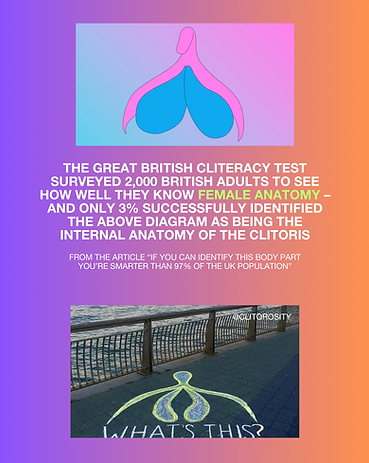
ON PEOPLE NOT BEING ABLE TO IDENTIFY THE CLITORIS
“The Great British Cliteracy Test by Lovehoney surveyed 2,000 UK adults to see how well they know female anatomy – and only 3% successfully identified this diagram as being the internal anatomy of the clitoris (despite 32% claiming they’d be able to recognise the internal structure of the pleasure organ).
It wasn’t just men who couldn’t put their finger on it – just 3% of women knew what the diagram showed vs 2% of guys.
While 90% of Brits claimed they knew the location of the glans clitoris (the visible part) only 30% accurately labelled it on a diagram.
In sex ed 66% were never educated about the clitoris and 78% said teachers failed to properly cover female pleasure. 16% of women taught themselves everything they know about their own anatomy. 22% of men learned about female pleasure and anatomy from a partner and 13% relied on porn. 18% of respondents turned to AI to ask about clitoral stimulation. This number is higher among men (23%) than women (13%) and highest among Gen Z and millennials.
‘Sex ed needs an urgent makeover,’ says Dr Suzanne Belton. ‘Generations of people are oblivious about their genitals or other people’s. Clearly when they’re rubbing genitals the biggest losers are heterosexual women, which likely contributes to their lack of orgasms.’
Despite the term ‘orgasm gap’ being around since the late 1990s, sadly it still hasn’t closed. 23% of men believe their female partner orgasms every time they have penetrative sex but just 11% of women say this is the case.
Lovehoney calls this the ‘orgasm assumption gap’ – the difference between perception of pleasure and really experiencing it.
Worryingly, just one-third of men focus on the clitoris during sex, when this is the main way women reach climax. 13% of women ‘almost never’ or ‘never’ orgasm from penetrative sex alone.
The full internal anatomy of the clitoris wasn’t mapped until 1998 and the first 3D images weren’t produced until 2008”
WORDS If you can identify this body part you’re smarter than 97% of the UK population (Metro, 6/3/26)
AND…
• The clitoris has over 10,000 nerve endings, more than double that of a penis.
It’s the only human organ whose primary function is pleasure

ON HOW GEN Z SEEKS OUT POSITIVE SEX & RELATIONSHIPS
About the “rapid rise of horny hockey show Heated Rivalry, journalist/erotic fiction writer Tyler McCall says: ‘The sex scenes in film and on TV have felt gratuitous because they’re intended more to seem sexy than actually being sexy. They’re not true to how sex happens in our real lives.’
Heated Rivalry follows the main characters from the ice to showers to hotel beds, with the nudity and creative blocking their graphic sex scenes require. But those sex scenes work for young viewers – who have gained a reputation for being less interested in sex – because of all the yearning in between. The sex is a necessary release for the characters’ pent-up desire every time they reunite.
The show is a ‘fascinating case study into Zoomers’, says Chelsea Reynolds, Arizona State University associate professor. Its enormous popularity among Gen Z-ers (born between 1997 and 2012) challenges assumptions that their generation is disinterested in having sex and seeing it depicted onscreen. Reynolds says young people ‘have a tremendous appetite for sexual content – they just want the sexual relationships portrayed to be healthy, consensual and ongoing.
Gen Z isn’t sexless or asexual – they’re just more cautious and more practical about approaching sex and romance as a package.’
Gen Z isn’t having much sex (32% of high schoolers in 2023 reported that they’d had sex vs 47% a decade earlier). In a 2025 survey of Gens Alpha and Z, 48.4% said there was ‘too much sex and sexual content in TV and movies’.
But they’re still horny. They’re not turned off by all sex onscreen; they just want it to feel real and romantic. They want love but they’re not doling it out to just anybody.
It’s hard to fault Zoomers for exercising caution around sex: many were in high school and college during Covid-19, they don’t have the abortion protections of Roe v Wade, there was the legislative attack on LGBTQ healthcare, so a lot of Zoomers don’t consider the potential pleasures of sex worth risks like STIs or unwanted pregnancies.
They want sex to happen inside a committed relationship (81% ‘have fantasised about monogamy’).
That longing for love is perhaps Heated Rivalry’s greatest appeal for young viewers starved for romance, says culture critic Madison Huizinga, age 25: ‘Gen Z is more trad than they’re given credit for. I don’t think it’s that they’re having less sex. They’re just having more intentional sex and creating more intentional relationships – not to dunk on millennials.’
Intimacy coordinator Katie Haan says of Gen Z: ‘They approach sex with more communication and mutual respect than previous generations. Gen Z isn’t afraid to ask for what they really want.’
Gen Z is ‘pretty good at spotting inauthenticity’ in onscreen sex, says McCall.
But the sex on Heated Rivalry is fun – it’s consensual, deeply gratifying for both parties and a form of connection. On other shows it can be gratuitous.
Psychologist Jean Twenge attributes Gen Z being turned off by most sex in media to their growing up among ‘ubiquitous porn’ and the shadow of the #MeToo movement: ‘They’ve seen enough porn online and want a different portrayal of sex in a streaming series.’
Huizinga says: ‘Heated Rivalry shows younger people who may not have had their first sexual or relationship experience that you can maybe have it all – you can have this hot, exciting encounter and then it can become something sweet and special and romantic’”
WORDS Gen Z isn’t sexless. They just want a love like Heated Rivalry (CNN, 5/3/26)
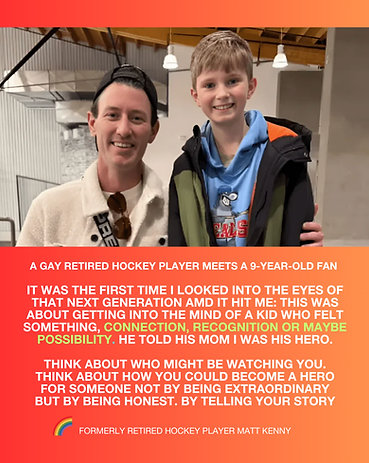
ON A FORMER GAY HOCKEY PLAYER BEING A HERO TO A BOY
🌈 “After formerly retired hockey player MATT KENNY watched the first episode of gay hockey show Heated Rivalry, he posted on his @matt_runs Instagram account: ‘It cracked me wide open, I had a panic attack, I couldn’t breathe and 20 years of memories and trauma came back.’
At the 3rd annual NHL Pride Cup – for LGBT+ hockey associations in the Pacific Northwest – he met a 9-year-old hockey fan and his mum who asked if they could take a picture together: ‘It was the first time I actually looked into the eyes of that next generation and it hit me: this was about getting into the mind of a kid who felt something – connection, recognition or maybe… possibility. He told his mum that I was his hero. For me it wasn’t just about rainbows. It was about connection, community and love of others and self.
Think about who might be watching you. Think about how you could become a hero for someone not by being extraordinary but by being honest. By telling your story’”
WORDS Gay hockey player called “hero” by 9-year-old at NHL Pride Cup (Out, 5/3/26)
AND…
• “Kenny played competitive hockey. But as a closeted gay kid he felt unsafe and walked away from the sport: ‘It was this heavy feeling that hung over everything, which was, you know, the fear, the joy, the secrecy of love that was never supposed to exist in daylight and, you know, internal homophobia amd shame – shame that players like me wore like a second skin.
I was giving everything to this sport and deep down I just knew that this sport I loved probably wasn’t able to love me back.’
Kenny has received hundreds of messages, not just from athletes but also from parents, telling him stories about kids being closeted and afraid: ‘So many younger people are living in shadows and living in fear of coming out.’
The NHL has never had an openly gay hockey player and in 2023 briefly banned rainbow tape used on hockey sticks to show support for LGBT+ people.
While the league backtracked after a player defied the ban, the sport has a reputation for hypermasculinity and a locker room culture that can include homophobic slurs.
Former gay pro hockey player Brock McGillis is on a cross-Canada tour, speaking with players about hockey culture norms. Players tend to discuss women, video games, sports, maybe music – but he wants them to feel able to talk with their teammates about things that really matter: ‘They adhere to these norms. A lot of my work is challenging them to be brave enough not to adhere to that, to share more of themselves.’
Kenny says Heated Rivalry will ‘change lives. We need more voices speaking up. We need more voices so that characters like that become real life, who maybe don’t even have to come out because it just becomes so normalised that they can just be that from the minute they kind of realised this was the way they are.
The little kid I was – that was so terrified of everything that I was and didn’t think the world could ever accept – is starting to realise that, you know, this world we’re currently living in might just be able to do so’”

ON HOW BRIDGERTON CAN HELP PARENTS TALK OPENLY
“The Netflix series BRIDGERTON gets one thing right: the taboos around talking about sex and sexual pleasure.
The newlywed character Francesca asks in hushed confusion what it means to reach ‘the pinnacle’ (orgasm). Her mother Violet says: ‘It is a delightful um, closeness, that is um, it’s nearly impossible to describe. It’s like a shared language. And when you speak the same language you are able to feel um [a] magical, special feeling inside.’
This dynamic mirrors what we see today: young people want information about sex and sexual pleasure, yet parents often feel awkward and ill equipped to provide it. Young people also want information about sex and relationships that emphasises emotions and pleasure but often learn from peers or online.
Meanwhile many parents share their discomfort when discussing the more intimate dimensions of sexuality. In our 2025 study of Australian parents, many said they were uncertain about how to initiate or sustain meaningful conversations about sex and relationships and what information was age appropriate, especially when kids may already find sexual content online.
Parents were more confident talking about body image, consent and safety, puberty and periods. But they were particularly uncomfortable talking about sexual pleasure, satisfaction and masturbation. They often connected this unease to growing up in homes where sex was rarely discussed openly. (In Bridgerton Francesca’s mum admits she struggles to talk about sex with her lover.)
Parents who felt more comfortable discussing sex with partners, friends or health professionals were more likely to feel confident talking about it with their child.
While Francesca searches for information about pleasure, a female housekeeper cautions her brother about power and responsibility when she notices his attraction to a housemaid.
This echoes contemporary differences in how sons and daughters are prepared for intimate relationships. Boys are positioned to manage power and consent, often with less space to explore ideas of love and romance.
Women are the default parent responsible for navigating these conversations. In our study, mothers reported higher confidence than fathers in discussing consent and safety with both daughters and sons, compared with fathers, particularly fathers of sons.
When we talk about sex only in terms of risk, focusing on pregnancy, infection and harm, we narrow the story young people can tell about intimacy. It can reinforce a familiar binary: boys as potential perpetrators, girls as potential victims and sex as something that ‘happens’ rather than something negotiated.
Leaving pleasure out of parent-child conversations makes conversations not safer but incomplete. Without a language for desire, boundaries and dissatisfaction, young people have fewer tools to recognise coercion, communicate their needs or imagine sex that is mutual and wanted.
We can’t expect young people, especially young women, to advocate for their own pleasure if they’ve never been given the vocabulary to understand what it is and what to expect.
Young people ask for clarity about the ‘mechanics’ of sex: how it works, what it feels like and how to do it. Parents play an important role in supporting this learning, particularly as sexual pleasure and wellbeing are among the topics less likely to be covered in school education, which has tended to focus on reducing harm.
If parents are reluctant to talk to their child about sex and relationships, it’s rarely because they don’t want to. Our study shows that they’re not certain what to say, when and how much detail to provide.
Many parents worried their child would feel uncomfortable, or feared saying the wrong thing. One in 3 had not had any conversations about sex or relationships with their child in the past year.
But unlike in Bridgerton, today’s parents are not confined to metaphor. Resources exist to support more open, direct conversations about bodies, relationships and pleasure, which young people want.
Talking about sex, especially pleasure, can feel uncomfortable. But this is not a reason to stay silent. It’s a sign that the conversation matters”
WORDS What Bridgerton’s “pinnacle” tells us about sex talk today (The Conversation, 25/2/26)

ON SHOWING SEXUAL PLEASURE IN WOMEN OVER 40 ONSCREEN
“In the Netflix series Bridgerton – known for its spicy sex scenes and heated entanglements – why is the romantic arc of Lady Violet at age
50 significant?
For decades MIDLIFE FEMALE SEXUALITY has been shown onscreen as nonexistent, in decline or subject to ridicule. But since the cultural reshaping of menopause in recent years, a growing number of shows and films are reframing what female sexuality can look like beyond age 40.
We first see Violet’s interest in romance when she awkwardly confesses to a friend that her dormant libido is stirring. Using the metaphor of a garden, she says that when her husband died: ‘I did not even think of the garden. I did not want the garden. But lately, without warning, the garden has begun to bloom.’
Then we find her ready to be tended to and determined to communicate her concerns and needs about moving towards a physical relationship, asserting: ‘My body – well, I have had 8 children with this body and I am different now. All of me is different now. And how will that be? I want it.
I want to be seen and touched. By you. [But] I am nervous.’
Her honesty provides the scene with a groundedness rare to the series.
When Violet invites Lord Marcus over for ‘tea’ he finds her seductively leaning against the bed in Regency-inspired lingerie. In
a fan-favourite line, she explains: ‘I am the tea that you are having.’
She has a newfound sexual confidence and her empowerment is bolstered by a female gaze geared towards emphasising her enjoyment.
The result of rarely seeing an older woman ‘yearning for sex’ is that we assume it must be ‘far behind them’, says US scholar E Ann Kaplan. Those who dare to desire after 40 are depicted as shameful or desperate. But studies show that postmenopausal women value sex and are sexually active. Psychosocial factors such as wellbeing, relationship quality and western ideas around youth and femininity play a significant role in how women feel about sex at midlife and beyond.
As Ruth Gemmell, age 58, who portrays Violet, argues: ‘People of all ages should have sex on screen. I mean, we are not dead yet’”
WORDS “I am the tea”: how Violet Bridgerton is making us rethink female pleasure after 40 (The Conversation, 26/2/26)

ON SHOWING FEMALE DESIRE ONSCREEN
“Sexual politics take a turn for the steamy in VLADIMIR, the Netflix series about a professor (Rachel Weisz, age 56) who, while coping with a scandal around her husband (John Slattery, age 63), becomes fixated on a hunky faculty member (Leo Woodall, age 29). It pokes fun at academia, where students hold radical views on sex and relationships.
Weisz’s performance navigates intricacies of desire, obsession and creativity. She breaks the fourth wall to address the audience, which grates on the nerves because the writing has a strained sense of humour exacerbated by her self-satisfaction.
Weisz’s smirky, suggestive comments to the camera convey the inner tumult of her character, whose life is in upheaval courtesy of her husband’s copious indiscretions with students. For decades they have shared an open marriage.
In terms of eroticism, Weisz’s protagonist is shaken by the arrival of Woodall, who awakens her lustfulness. He is apparently clueless about his older colleague’s interest in him. The dad of a 3-year-old, he is the all-consuming object of Weisz’s desire – there’s nary a moment when, while in his presence, she isn’t thinking about him touching, kissing or seizing her in a passionate embrace.
Weisz’s intrusive fantasies are a cute feature until they become so omnipresent they lose their potency.
In a feature film, a few reveries would be a playful expression of her need to feel wanted and how that hunger is tangled up with her creativity. In an 8-episode show they grow monotonous fast.
Randy innuendo abounds – when coupled with Weisz’s daydreams about getting it on with Woodall, the series occasionally gets the pulse racing.
Through Weisz’s interactions with her students and daughter, the show strives to generate prickly comedy about contrasting generational attitudes towards intimacy and identity.
But the idea that Weisz is ‘unblocked’ as a writer via a rekindled libido is corny and the wannabe-spicy shenanigans disprove the series’ belief that sex leads to artistic inspiration”
WORDS Two Smoking Hot Stars Can’t Save This Netflix Sex Romp (Daily Beast, 5/3/26)
AND…
• “Rachel Weisz’s scandalous new series is her raunchiest role yet as she is seen performing X-rated sex scenes with Leo Woodall. She is seen fantasising about getting intimate with him – even performing a sex act on herself in the second episode.
Weisz speaks directly down the lens as she introduces her character to viewers – who were sent wild by the action.
‘It has recently come to my attention that I may never again have power over another human being,’ she says. ‘While it may be possible that a man might make a concession for me, I may not be the cause of a spontaneous erection ever again.
As an older woman, truly what is more embarrassing, I will have lost the ability to captivate…’ she adds as the camera pans to Vladimir, slumped over and tied to a chair.
The Daily Mail gave the series a 5-star rating, calling it a ‘spellbinding, sexually charged romp. Vladimir is a darkly comic exploration of desire… sly and incisive and delicious’”

ON HOW THE ANDREW STORY AFFECTS YOUNG PEOPLE & WOMEN
“Recently I spent time with UK teens aged 13 & 14. About their slang
du jour: when one of them does something jokingly inappropriate, the others shout: ‘EPSTEIN!’
‘Don’t Epstein me,’ said a boy whose mate tried to stuff a chocolate bar down his trousers.
‘Get off, Epsteins!’ a girl retorted when the rest tried to form a human pile-on.
Epstein as a byword for assault, lack of consent, misconduct, predatory behaviour; for the woolly, half-conscious awareness of power dynamics, youth, vulnerability and unwanted physical contact.
Epstein as a way to call it out, to say no. As a warning, a way to signpost ‘I recognise this for what it has been for others and what it could be.’ Epstein as: ‘I see you.’
It felt like a classic teenage ‘joke’ with serrated edges. Distasteful, certainly. Yet the only way kids can make sense of the horror they have heard and read about. The only way they can process what adults have done and in some cases continue to do to young people like them.
I look at the latest lurid photos of the former prince Andrew hunched on all fours over the prone, seemingly unconscious body of
a much younger woman and I want to weep. I want to scoop up my daughter and her friends, protect them from harm at the hands of men like this.
Because I’ve known men like this. Now in my 40s, I recall men who sought to hurt me and my friends, who took pictures of us a little like this.
The faces of men like this were found in the defendants winding out of court during the Gisèle Pelicot rape trial.
My first thought when I saw the image, with its stark intimacy of detail (Andrew’s bare feet, casual polo shirt, hand resting on the stomach of the young woman), is that it feels like a violation.
Perhaps what makes the photo so troubling is that we don’t know what happened afterwardss, the identity of the woman, why the photo was taken or who took it; if it was posed or casual, set up as role-play and fooling around, or downright predatory.
We don’t know if the woman gave permission for it be taken, if she’s even awake. We are left wondering if we should shout ‘Epstein’ as a ‘joke’ or whether it is all too real.
We know that the former prince has been accused of ‘hiding’ by US officials after he was invited last year to appear before the US House oversight committee. We know that prime minister Keir Starmer said Andrew should testify before Congress about his links to Epstein. We also know that Mountbatten-Windsor has always denied any wrongdoing.
We know… and we don’t know. And so we are left with the word ‘Epstein’ – with all of its darkness, its unsavoury connotations – echoing around an empty room long after any laughter has faded away”
WORDS Every woman will recognise the same awful thing from these latest Epstein photos (The Independent, 2/2/26)

ON THE PROLIFERATION OF EPSTEIN MEMES
“The EPSTEIN files are flooding social media. Screenshots of
Jeffrey Epstein’s emails are posted on X, Bluesky & Instagram
with punchlines. His name trends next to jokes, reaction GIFs
and ironic captions.
Something chilling is happening: Epstein’s extensive sexual-abuse network is being processed by the internet as a meme.
When Epstein becomes a punchline, the crimes attached to him and his powerful friends – rape, trafficking, the systematic abuse of girls and young women – are abstracted. The bodies of his victims, abused and exploited – photographed while they were abused, discussed casually in emails by powerful men – are transformed into something laughable. Irony creates distance from horror.
AI-generated videos of Epstein dancing proliferate on TikTok.
One AI video shows Epstein walking down a red carpet, making eye contact with Sean ‘Diddy’ Combs, the convicted sex abuser.
A video of an Epstein rave has 62,000 likes. A ‘looksmaxxing’ account imagines how Epstein might look if he ‘locked in’ (incel-coded language for maximising sexual appeal) – it’s a crossover between Epstein meme culture and the manosphere.
On TikTok #JeffreyEpstein is linked to over 64,000 videos, many of them memes. But in one real email, a popular object of online analysis and commentary, Epstein says: ‘I loved the torture video.’
The meme-ification of the Epstein files seems to function as a pressure-release valve: it allows public engagement without moral reckoning. You don’t have to sit with horror if you’re laughing. When the story becomes a joke, you don’t have to ask who enabled him, protected him, benefited from his silence or joined in on his abuse.
It is a classic Trumpian move in a govern-by-meme administration: overwhelm the public until an internet-culture tone replaces truth. When everything is shocking, the shock dissipates. Accountability dissolves.
The victims dissolve too. Their actual bodies had already been circulated among abusers. Now they circulate online – their faces covered in black, bodies vulnerable, sometimes in minimal clothing or naked – as internet fodder.
Emma Connolly, a social media researcher at University College London, says memes of Epstein’s abuse ‘obscure the severity and reality of the crimes… taking the focus away from his victims’ and that meme culture ‘spreads quickly and normalises harmful topics by presenting them in humorous and engaging ways’.
Some images shared tens of thousands of times are impossible to forget: a woman’s foot inscribed with a quote from Lolita; Andrew Mountbatten-Windsor pressing his hands leeringly into a young woman’s body.
Meme-ification means the difference between real and generated is fatally blurred.
The circulation and meme-ification of such images produce a visual salaciousness. The realities of Epstein’s crimes are obscured by a torrent of images.
The Epstein files document a system in which wealth insulated abuse, institutions failed children and powerful men relied on the expectation that they were untouchable. Laughing can help us process the horribly traumatic, but here it further exploits the victims of Epstein and his friends.
What is required is sustained attention and moral clarity, an insistence on seeing these crimes as systemic and unresolved. Without that, the noise does what it was designed to do: protect power, erase victims and ensure that nothing truly changes”
WORDS Epstein has become a meme, not a monster (The Observer, 4/2/26)

ON THE IDEOLOGY BEHIND CLAVICULAR, THE NEW ANDREW TATE
The term mogging, which comes from AMOG (alpha male of the group), is “a manosphere-adjacent set of laws decreeing that boys must be mega attractive. This means Adonis-level facial proportions, a ripped and fat-free body, tall (over 6ft, hence a new interest in bone smashing), and beautifully dressed and styled.
Gen A (alpha, born 2010-24) boys are encouraged to take things to extremes. They have similar levels to Gen A girls around eating-disorder diagnoses and mental-health disorders connected to anxiety about how they look.
A name that comes up in talks with boys about looks and vanity with the same kind of frequency and intensity as Andrew’s started to around 2021 is CLAVICULAR – real name: Braden Peters, age 20, a ‘looksmaxxing influencer’ with a huge and growing Gen A boy following. He is evangelical in his belief that a young man’s highest priority is to be hot, hot, hot – or mog.
To achieve maximum mog, Clavicular has whacked himself in the face with a hammer and reportedly tried crystal meth to control his appetite and remain ripped. He views the world with a sort of beauty nihilism, where the beautiful matter.
In December 2025 Clavicular, commenting on US politics, called vice-president JD Vance ‘subhuman’, not because of his treatment of citizens but because of his looks. He criticised Vance for having ‘a recessed side profile’ and ‘being obese’, questioning: ‘How are you fat and expected to lead a country?’
Clavicular called Democrat Gavin Newsom a ‘6’3 handsome Chad’, saying he’d vote for him because ‘he totally mogs Vance’. This despite Clavicular believing Newsom is a ‘degenerate’ and a ‘liar’.
At this point, women around the world might just be feeling a slight inkling of justice. After all, girls and women have been subjected to similar beauty standards and cruel assessments of their looks for centuries. But the global obsession with looks and beauty, now rife in young men, is symptomatic of something dark in younger generations.
Gens A and Z believe beauty is a ticket to wealth, fame and popularity. For the beautiful or those who mog, there are followers, brand deals, CyberTrucks and sex on tap.
Teenagers have always worried about their looks; those years are a perfect storm of hormonal anxiety and a new biological impetus to attract a mate by standing out from the pack. But technological shifts and a new guard of influencers are pushing Gen A through the looking glass of normality and reality. Human beauty is no longer enough – young people are hammered with AI depictions of beauty that aren’t achievable, so they are encouraged to seek them by any means necessary.
It distorts what happiness and success are. I’ve spoken to thousands of Gen As who view what were considered elite, aspirational job roles like surgeon, architect, writer or spy as ‘failures’ – something you do if you’ve failed to become a content creator or CEO of something vague, usually funded by crypto. If a little bone crunching is required so you can commandeer a CyberTruck and tell your millions of followers to vote for the guys who mogs, so be it.
It’s time to pull young people back into the real world, where how you look still does matter, but we care about other things, people, places, ideas and the relationships you make along the way more than how much you mog”
WORDS Braden Peters is the new Andrew Tate: What every parent needs to know about teen boys and “mogging” (The Independent, 1/2/26)

🌈 Discussing LGBT+ HISTORY MONTH can be a way in to talk with your child – whether they’re LGBT+ or an ally – about LGBT+ people and issues.
It’s held in the UK every February to mark the month in which, in 2003, the damaging law Section 28 – which prevented the “promotion” of homosexuality in schools – was abolished. “It meant children and young people growing up in the 90s didn’t see or hear about same-sex relationships,” explains BBC Newsround for kids. “The lack of acceptance in everyday society meant that homosexual people felt isolated. It also meant homophobic views were made worse.”
In this time of LGBT+ political and social backlash, we still need to counter harms such as hate crime, conversion therapy and discrimination in, for example, sports.
Talking about LGBT+ people and issues “claims our past, celebrates our present and creates our future”, observes Schools OUT. The charity’s aim: to “educate out prejudice” and “usualise LGBT+ lives”.
So bring up these LGBT+ science and innovation heroes with your child…
• Mathematician, logician & computer scientist Alan Turing is considered the father of AI
• US astronaut, physicist & educator Sally Ride was the first woman in space
• US neurobiologist Ben Barres, an openly trans scientist, revolutionised brain cell study
• Medical researcher Barbara Burford established NHS equality & diversity guidelines
• Botanist Elke Mackenzie did pioneering research on lichens in Antarctica
• Locomotive engineer Charles Beyer co-founded the Institute of Mechanical Engineers
• Biotechnologist Jemma Redmond developed 3D bioprinters to create tissues & organs
• Chemist Robert Boyle modernised science by championing controlled experiments
And check out the LGBT+ History: Pride in STEM Pack posters from the ever-colourful and informative Pop’n’Olly…
With your child, look Top 5 Facts About LGBT History Month For Kids, Just Like Us resources and LGBT+ superheroes at BBC Bitesize for kids. The Proud Trust’s People Like Me highlights a few famous LGBT+ people plus allies – fill in the blanks with the many others you and your child can think of! (Also see the stars we compiled in our blog post “Discover Who Your Child Is – That’s An Adventure”.)
We love the idea behind this year’s logo, designed by ecology scientist Dr Robin Hayward, an expert on queerness in nature: “Chemical reactions occur when different materials are brought together and mix – just as our diverse identities can, acting in community, bring about sudden and creative change.”
Let’s ignite this kind of combustion by flying the flag 🏳️🌈 and talking openly at home!

🌈 “For LGBT+ History Month here are some SUPERHEROES WHO MAKE UP PART OF THE LGBTQ+ COMMUNITY…
PHASTOS Marvel’s Eternals (2021) tells the story of 10 powerful beings banding together to protect planet Earth, including the Marvel Cinematic Universe (MCU)’s first openly gay superhero. A master inventor, Phastos (Brian Tyree Henry) uses cosmic energy to create advanced weapons for the Eternals and help humanity progress from the shadows. The film features Phastos’ husband and son
VALKYRIE (Tessa Mae Thompson) is a queer character introduced in Thor: Ragnarok (2017). A hit with fans, Valkyrie was crowned King of Asgard by Thor. She also starred in Thor: Love And Thunder (2022). Thompson confirmed her character’s queerness at the Comic-Con convention when she said Valkyrie’s first order of business as king is to ‘find her queen’. Valkyrie was bisexual in the original comics and Thompson, who is bi, tweeted that the character’s sexuality had a big part to play in shaping how she portrayed her
DEADPOOL A very un-PG anti-hero who appeared in 2016, he is thought by fans and the comics’ writers to be pansexual because when he flirts he makes no distinction between genders. (Pansexuality is defined by LGBTQ+ charity Stonewall as ‘a person whose romantic and/or sexual attraction towards others is not limited by sex or gender’.) Miley Cyrus identifies as pansexual
BATWOMAN aka Kate Kane (created in 1956) was originally Batman’s girlfriend, but in the 2006 comic she’s a lesbian. Her sexuality is revealed when she is kicked out of the military because she broke the Don’t Ask Don’t Tell clause (a real-life US law, repealed in 2011, that allowed LGBTQ+ members of the military to serve if they keep their sexual identity a secret). The Batwoman series hit screens in 2019
ICEMAN was a ladies’ man until 2015, when his younger self time-travels and confronts his older self about his sexuality, leading the older Bobby to decide not to hide who he really is. The character’s creator, the late Stan Lee, told BBC Radio 4 he didn’t mind a bit: ‘I don’t care what happens as long as they tell good stories. And they do’”
WORDS Five LGBTQ+ superheroes you need to know about (BBCBitesize, 2/26)

ON THE APPEAL OF GAY HOCKEY SERIES HEATED RIVALRY
“The Canadian hockey romance that became a global sensation, Heated Rivalry shows a sexy love story grounded in equality, vulnerability and authenticity. It follows Shane Hollander and Ilya Rozanov, hockey players at odds on the ice who develop a deep, intimate relationship off it. Their connection isn’t built on danger, dominance or emotional sabotage. It unfolds through mutual attraction, secret longing, cultural difference and eventually openness.
It’s rare to see super-hot and passionate depictions of sex between 2 people who share equal social power. Shane and Ilya’s sexual relationship is steamy – and that comes from emotional honesty, consent and mutual desire.
Both choose vulnerability over dominance when they’re together. That’s sexual connection rooted in mutual respect.
Teens are swimming in romantic stories and also porn. They read, watch, compare and learn what we academics call sexual scripts that dictate what should happen. Teens absorb all of this long before they’ve had enough real-life experience to contextualise what they’re consuming.
When the romantic and erotic fiction girls consume consists of a love story or porn scene where control and domination are disguised as passion, it shapes expectations: love hurts.
Stories like Heated Rivalry offer a different lesson: passion can grow from vulnerability, hot sex doesn’t have to be controlling or dangerous, love requires mutual respect.
This show signals that passionate sex doesn’t have to be predicated on power imbalances. Heated Rivalry (and young women’s obsession with it) demonstrates that there is an audience that wants to watch exciting sexual relationships that aren’t steeped in self-destruction.
I’m not suggesting that teens should watch the show. But here are healthy sexual relationship messages you can communicate to them…
• Desire thrives without ownership – Freedom and autonomy can create sexual tension
• Clear consent heightens anticipation – The sexual encounters are marked by checking in, reading cues and responding to the other person’s comfort and enthusiasm. Mutual awareness turns intimacy into collaboration, not conquest
• Emotional vulnerability is foreplay – Heated Rivalry shows emotional openness as a turn-on
• Sex doesn’t ‘fix’ people – Shane and Ilya’s relationship grows because they talk, reflect and respect each other’s boundaries
• Power is contextual, not relational – On the ice Shane and Ilya are rivals. In private, the power constantly shifts”
WORDS The Virgin-Beast Trope (Teen Talk Tuesday blog post by Dr Megan Maas, 3/2/26)

ON THE PENISGATE RUMOURS AT THE WINTER OLYMPICS
“A plastic surgeon added a new layer to the ‘penisgate’ controversy at the Winter Olympics. Alessandro Littara, who has performed over 3,000 penis-enlargement operations, said he provided the surgery – with hyaluronic acid – to a ski jumper last month.
This month German publication Bild reported that Olympic ski jumpers were using hyaluronic acid injections to artificially enlarge their genital area, which would allow them to wear bigger ski jumping suits. Bigger suits would help generate more lift on jumps & make it more aerodynamic, potentially adding a few extra metres in the air.
Littara claimed that the ski jumper he operated on said he wanted to avoid embarrassment in the dressing room: ‘I cannot say whether he told me the whole truth. But we did a good job and implanted a more than generous dose of hyaluronic acid. The result is immediate, so the athlete could wear the new suit after just a few minutes.’
The World Anti-Doping Agency said there will be an investigation, while the International Ski And Snowboard Federation communications director Bruno Sassi said there was no evidence it was happening at these Olympics, calling the allegations ‘pure hearsay’ and a ‘wild rumour’.
The 3 US ski jumpers said they did not know of anyone doing it but did not rule it out. Jason Colby explained: ‘It is difficult to say if it’s something that has been done or if people are doing. I guess that, scientifically speaking, it could work. But who knows what other teams are doing behind closed doors’”
WORDS Plastic surgeon pumps more drama into “PenisGate” at Olympics with injection claim (New York Post, 16/2/26)
AND…
• Aerodynamics expert Prof Christopher Roy: “I don’t know how to put this delicately. If it’s creating a bulge in the crotch area, that would actually have a very detrimental effect. But if it somehow increases the surface area while maintaining a smooth aerodynamic shape on the body, then that could have an (advantageous) effect”
• “Olympic ski jumper Casey Larson said: ‘It’s super addicting, flying through the air like a squirrel.’ He added that he wouldn’t have ruled out sticking ‘a needle down there’ had he known about the procedure before he retired: ‘It’ll make you a better skier. It will allow you to fly farther. Big suits help you fly and make you feel like a flying squirrel’”

FEMALE ANATOMY WILL FEATURE AT THE CHELSEA FLOWER SHOW
“The Lady Garden Foundation charity hopes its Silent No More
garden – which will be showcased on the Main Avenue at this year’s Chelsea Flower Show in May – will spark conversation around the 5 gynaecological cancers: cervical, ovarian, womb, vaginal and vulval.
‘Every person that’s had a big impact on my life has been a woman.
Why would I not want to say something about this? Men need to be part of this conversation too,’ says garden designer Darren Hawkes.
About 60 women a day in the UK get a gynaecological cancer diagnosis and 21 will die of one of these cancers, despite it being one of the most preventable. Many deaths can be prevented through earlier diagnosis, yet the UK rate lags globally partly because of stigma, low awareness, misdiagnosis, procrastination and overlooked symptoms.
In a 2025 Lady Garden Foundation survey, 46% of 1,018 women aged
25-64 didn’t attend cervical smear appointments. Barriers include lack of time, embarrassment and low perceived risk.
Cervical cancer survivor Rachel Lambert says: ‘There’s a lot of stigma around talking about that part of your body. Women need to say:“This
is my body and I need people to listen to me”’”
WORDS Chelsea Flower Show encourages survivors of women’s cancers to speak up (The Times, 23/1/26)
PLUS…
• Hawkes says: “My design features forms and planting that echo the female body to invite curiosity and encourage conversation about these cancers.I hope to be a role model for men – to encourage awareness, empathy and dialogue around women’s gynaecological health.As a husband, father and son to important women in my life, I want to expand awareness among men and women, break taboos and shatter the silence to help save lives”
• On changing the conversation around gynaecological cancers, the Lady Garden Foundation says: “A garden, like a conversation, needs space, attention and care to grow.We want people to walk away talking – about their gynae health, the symptoms they shouldn’t ignore and how we can all play a role in ending the stigma surrounding gynaecological cancers”
• The charity’s 2025 survey shows that of 15,665 students aged 18-22, 78% cannot identify the symptoms of the 5 gynaecological cancers. Only 21.4% were aware that there are 5 types

ON HOW A DAD CAN HELP THEIR GIRL WITH HER FIRST PERIOD
“As a dad, supporting your daughter through her first period can feel like a tall task. Having navigated this pivotal life event with my girls,
I sympathise. But with some preparation, you can serve your child well during a very normal, though emotionally complex, puberty milestone with education and compassion…
TALK ABOUT PUBERTY EARLY ‘At ages 7-9 many kids hear about periods from peers or media,’ says Dr Kerry Krauss. ‘Short explanations over time normalise body changes. Starting earlier supports confidence and reduces stigma’
USE RESOURCES VETTED BY PROFESSIONALS Consult sites run by, say, the American College of Obstetricians & Gynecologists and books like Celebrate Your Body 2, The Care and Keeping of You, It’s Perfectly Normal [and Own Your Body by Chella Quint]. Resources work best in concert with conversation: what your kid really needs to weather the changes happening in their life is support from you. You can say: ‘I’m always here to answer questions’ or ‘I’d like to be as much a part of this process as you’re comfortable with’
BE REASSURING Prepare your child for the reality of menstruation, which can be messy or painful, but don’t scare them. ‘Try not to dramatise the discomfort,’ says Dr Christine Greves
BRAINSTORM A SHORTLIST OF TRUSTED ADULTS such as family members, family friends, a school nurse or a favourite teacher. Look, even if you play all of your cards right, it’s likely your child will want to look to someone in addition to or other than good ol’ Dad for direct support and guidance. This can be especially true when it comes to insights on how to use period products, for example. Don’t feel hurt that you won’t always be your daughter’s go-to source for information and support
BE CAREFUL WITH HUMOUR It’s common to use humor to defuse discomfort. But think twice before busting out that dad joke or making light of the situation when your child starts their period. Even if humour and teasing are standard between you, this moment calls for a thoughtful response. ‘Acknowledge it with calm and positivity,’ says Dr Krauss. “‘his sends out the signal that periods are normal, healthy and nothing to hide. If you feel unsure, asking: ‘What would be most helpful for you right now?’ opens space for your daughter to guide the moment
MAKE A FIRST-PERIOD STARTER PACK OF SUPPLIES Let your child pick out a small pouch for period products, genital-safe wipes and pain relief – enough to get through a schoolday or outing with friends. Include something fun like candy and a note: ‘You’re amazing, and I love you! Call if you need anything Call if you need anything’ can be a meaningful connection point
MAKE ROOM FOR ALL KINDS OF FEELINGS The biological realities of a first period can be a lot for your kid to wrap their mind around, and a lot of kids are flooded with big and complex feelings when starting their period. ‘Parents often minimise the moment or normalise things too quickly,’ Dr Krauss says. ‘Be careful not to focus on the logistics without acknowledging the emotions. Many kids feel excited, embarrassed or anxious all at once.’ Maybe your child will need a hug or time to process it privately before talking about their experience. If parents don’t themselves feel a sense of shame or discomfort around it, then kids will feel comfortable asking questions and tend to be more emotionally prepared
TALK TO YOUR DAD FRIENDS Obviously, dads lack first-hand experience when talking to daughters about their first period. But you can lean on the experience of other dads to learn what worked well for them and what pitfalls they wish they’d avoided”
WORDS Dads, Your Daughter’s First Period Doesn’t Have to Be Awkward – Here’s How to Help (Parents, 28/1/26)

ON DIVERSITY IN TOYS
“An autistic Barbie that reflects some ways people with autism may experience and process the world is joining Mattel’s line celebrating diversity that includes a blind Barbie and dolls with Down syndrome or vitiligo. It was designed in partnership with the Autistic Self Advocacy Network.
The eyes of the latest Barbie Fashionista shift slightly to the side to represent how some people with autism sometimes avoid direct eye contact. This Barbie also has articulated elbows and wrists to acknowledge stimming – the hand flapping and other [repetitive] gestures that some autistic people use to process sensory information or to express excitement. The dolls come with a finger-clip fidget spinner, noise-cancelling headphones and a pink tablet modelled on the devices some autistic people who struggle to speak use to communicate.
The Barbie’s facial features were inspired by Mattel’s employees
in India.
In 2023 the first doll with Down syndrome was launched and last summer a Barbie with type 1 diabetes arrived. Other Fashionistas have a prosthetic leg or hearing aids, or represent tall, petite and curvy body types and numerous hair types and skin colours”
WORDS Mattel adds an autistic Barbie to doll line devoted to diversity and inclusion (ABC News, 22/1/26)
AND…
“Social science researchers have claimed that Barbie – regardless of neurotype – has historically been reductive and problematic. Barbie is unachievably thin, extremely feminine and all too often white. But Barbies have a reach beyond other brands and their range of disabled Barbies feels important to raise awareness.
Autistic people are so rarely depicted in media and entertainment, so it’s no wonder most people don’t really understand much about the neurotype.
Autistic Barbie’s existence is an overall positive. Her inclusion creates a much-needed opportunity for representation and education, and it normalises the use of disability accommodations”

ON THE AI TOOL GROK
“AI-generated images digitally alter real women and girls into sexualised scenarios. Image-based abuse is running amok on TikTok.
Half a million UK teens have encountered AI-generated nude deepfakes and about 50% of kids aged 8-15 have seen deepfake content online.
The ‘Put her in a bikini trend’ is online violence. Treating it lightly obscures its real-world harm.
[In August the AI tool] Grok was found producing sexually explicit content involving stars like Taylor Swift, whose likeness Grok – or rather human users using Grok – manipulated. North West (the daughter, age 12, of Kim Kardashian and Kanye West) also has been targeted.
The UK minister for Safeguarding and Violence Against Women and Girls (VAWG), Jess Phillips, vowed to ‘deploy the full power of the state to make this country safe for women and girls, both online and off”.
But digitally undressing women and generating images that sexualise children is not a new misuse of AI. It’s image-based sexual abuse enabled by deliberate design choices and allowed to go on unchecked thanks to an unwillingness to treat harm to women and girls as urgent
or enforceable.
Terms like ‘nudifying’ or ‘fake images’ minimise what victims experience: it’s sexual assault, says legal expert Professor Clare McGlynn. Impacts include hypervigilance, social withdrawal, distrust and fear that any notification could mean more abuse.
‘These images are created and shared to humiliate, silence and push women off public platforms,’ McGlynn says.
‘We all suffer from this mass sexual harassment of women. Because all women now know the threat of being online.’
Dr Arghavan Salles, of Stanford’s Clayman Institute for Gender Research, is vocal about what Grok’s outputs reveal about power, misogyny and control: ‘The men taking pleasure in violating women and children digitally are doing so for the sake of violation, not because they can’t find sexual images or videos – even abusive ones – online. The porn industry exists. But these men intentionally seek out non-sexual images and sexualising them without the consent of those in the photos because it is the violation of another person’s autonomy, the humiliation, the degrading that they enjoy.’
The ease with which Grok allows images to be manipulated – publicly, instantly – changes the risk profile. Unlike with earlier deepfake tools, you don’t need any technical expertise or external platforms to quickly and easily generate a deepfake. After a short prompt, the image is – moments later – live on one of the world’s largest platforms.
For Jurgita Lapienytė of Cybernews, the most troubling aspect of the Grok controversy is how long it was allowed to fester. In August, Grok was generating sexually explicit content involving public figures. Watchdog groups warned xAI exactly would happen if this wasn’t fixed: ‘We’re now seeing children as young as 10 being sexualised.’
McGlynn says: ‘This is about a failure to take the sexual harassment of women seriously’”
WORDS Grok’s AI Sexual Abuse Isn’t a “Trend”, It’s a Threat to Women (Marie Claire, 9/1/26)

IMPACT OF PORN ON KIDS
“For young people, porn can be a first sex-ed ‘teacher’ sometimes before puberty or before kids have a genuine interest in sex. But what is shaping their understanding is an endless flow of explicit, accessible, algorithmically tailored material.
In adolescence, when the brain is wiring rapidly, these images and narratives can influence how young people perceive their body, desires and identity. These expectations can persist into adulthood.
Porn can be a harsh benchmark – teens often compare their body, attractiveness and imagined sexual performance to adult actors whose role is to look flawless and always enthusiastic.
Boys may feel pressure to perform, dominate or initiate in ways that seem unnatural. Girls may feel expected to be constantly willing, pleasing or tolerant of behaviour that doesn’t align with healthy intimacy.
The Institute For Addressing Strangulation found that 35% of UK 16- to 34-year-olds were choked at least once during consensual sex.
Often disconnected from intimacy, consent, respect and emotional connection, porn can provoke embarrassment during romantic encounters, avoidance of intimacy or a paralysing fear of not ‘measuring up’.
Repeated exposure can establish a ‘sexual script’ for how sex should happen and expected roles.
When these scripts develop early, before romantic experience, they can become the default pattern.
Porn reduces sex to mechanics and acts without what makes it meaningful: consent, affection, communication, trust. The intimacy is performative.
Because of porn, many young people are unsure about what ‘normal’ intimacy looks like. They may expect encounters to be aggressive, choreographed, emotionless or violent.
This mismatch can cause disappointment, pressure and disconnection.
What can parents do?
• Start talking earlier than you think you should. Age-appropriate conversations about bodies, respect and boundaries can begin in primary school
• Normalise curiosity, don’t shame it
• Explain what porn is and isn’t
• Talk about consent, respect and communication
• Keep the door open with ongoing small talks
Parents can help children develop healthier understandings of sex, intimacy and themselves. When adults become a reliable source of guidance, even if the conversations feel uncomfortable, porn loses its power”
WORDS Porn is now the first sex educator for children (Irish Examiner, 6/1/26)